I wanted a super dweller. Just one, or maybe a team of three, stat-maxed and quest-ready. So I did the thing every Fallout Shelter player eventually considers and never admits out loud. I started my own FEV, except instead of a virus in a vault full of mutants, it was a spreadsheet of SPECIAL stats and a couple of dwellers I decided were going to be founding fathers.
I figured this would take a week. Conception to birth to a fully grown adult dweller only takes a couple of hours in this game, so the math seemed obvious. Pair the two best dwellers I had, wait a few hours, get a kid better than both of them, repeat until I had my team. That was the plan. That is not what happened.
The Bene Gesserit Problem
If you know Dune, you already know where this is going. The Bene Gesserit didn’t just pair people at random and hope for a good outcome. They ran a breeding program across generations, aiming at a specific result, tracking lineages, being deliberate about who bred with who. That’s basically what I was trying to do in Fallout Shelter, except my Kwisatz Haderach was going to be really good at fixing the water purifier.
The problem is that “deliberate” and “fast” don’t go together here. A single generation doesn’t get you a maxed dweller. It gets you a dweller slightly better than the worse parent and hopefully somewhere near the better one. To actually stack stats meaningfully, you need multiple generations, which means the one week plan turned into an ongoing project. Building up, not skipping ahead.
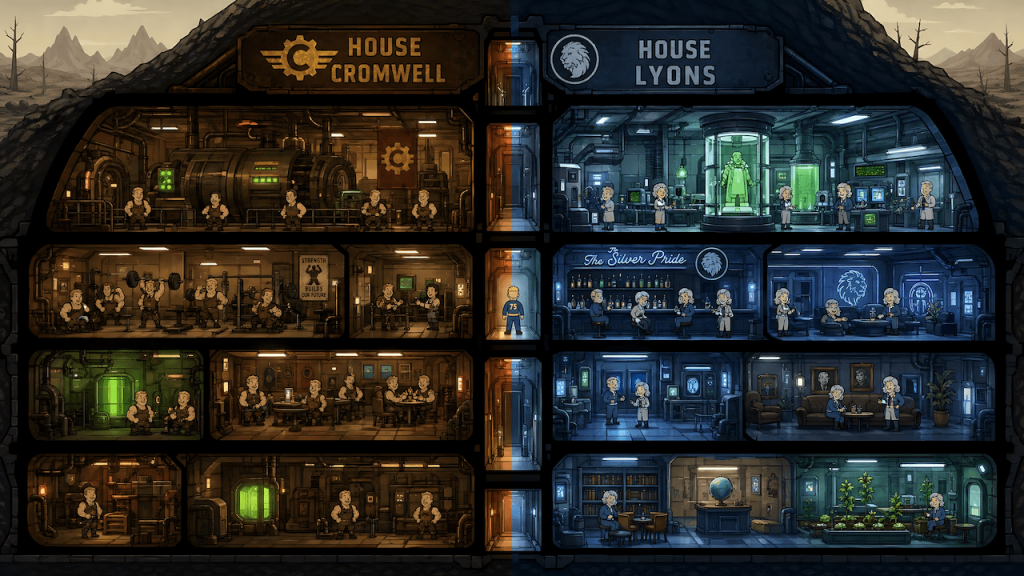
Two Founders, Two Houses
I started with two dwellers as my base breeding stock. Confessor Cromwell and Elder Lyons, both named after Fallout lore figures, both picked before I had any idea what their bloodlines would actually produce.
Cromwell’s kids came out strength leaning, all sons so far, hair running brown to light brown with almost no variation. Lyons’s kids came out intelligence, charisma, and occasionally luck leaning, mostly daughters, hair frequently silver like the father but breaking to the mother’s color more often than not. I didn’t plan two houses. I planned one breeding program. The game split it into a rivalry on its own.
The Lyons naming turned out to be an accident with a punchline. Elder Lyons’s actual claim to fame in Fallout 3 lore is his daughter, Paladin Sara Lyons. I named the house after him before a single kid was born. I had no idea the game was going to make the house skew female too, mirroring the one detail from the source material I wasn’t even thinking about when I picked the name.
At that point it stopped being a spreadsheet experiment and started looking like a Game of Thrones subplot. Two houses, distinct in appearance, distinct in specialty, existing in the same vault without touching.
What the Data Actually Showed
Here’s where the numbers get interesting, and where I stopped trusting the vague “it’s mostly RNG” answer you find on forums.
When I paired a low stat mother, someone sitting around 1 or 2 across the board, with a high stat father, the kid landed somewhere in the 2 to 4 range on average, but still dipped to 1 or 3 on whatever stat the mother was weak in specifically. That’s not a flat average across the whole SPECIAL sheet. It reads more like each stat gets evaluated on its own, pulled toward whichever parent was stronger in that specific category, with the weak parent still dragging their own weak spots down individually.
Then I paired Lucy, a genuinely high stat dweller, with both Cromwell and Lyons separately. In both cases, where the two parents already agreed on a stat being high, the kid matched that value instead of regressing toward some lower number. That’s the part that convinced me this isn’t a wide random roll every time. The variance seems to shrink the more the parents already agree.
Appearance turned out to be a completely separate system from stats. Daniel Cromwell and Emily Lyons both broke from their father’s hair color to their mother’s, despite both carrying their father’s stat lean and surname. William Lyons kept his father’s silver hair. Naming sometimes followed the mother instead of the father too, with no obvious pattern I could tie to stats or looks. Whatever is rolling hair color and surname, it’s not the same roll deciding SPECIAL.
By the time I had six Cromwell kids and six Lyons kids, the split held. Six for six, Cromwell sons. Lyons ran four daughters to two sons, a real skew even if it wasn’t the near-total female sweep I initially remembered. One of those two sons almost didn’t register as anything worth a second look. Just one of two males in an otherwise female-leaning house. I filed him under “one of the exceptions” and moved on to the next pairing. That was a mistake, because that son was Scott.
The Line I Didn’t Cross
I never crossbred the two houses. Part of that is the Game of Thrones bit, obviously, keeping two rival houses separate is more fun than merging them. But there’s a more honest reason underneath the joke.
Breeding programs get uncomfortable fast once you actually think about what you’re doing, even when the “people” involved are a few kilobytes of sprite data. The animal kingdom does inbreeding without a second thought. My dwellers still look and act like little people, and that’s enough of a line for me that I kept the houses separate on principle, not just for the bit. It’s already a little strange running something that functions like a harem and a birthing program even in a mobile game. I wasn’t going to add incest to that pile just to see what the stats would do.
Practically, this also means the whole operation needs fresh outside dwellers constantly. New mothers from the wasteland, radio recruits, lunchbox pulls, whoever, cycled in specifically to keep each house’s gene pool from running into itself. It’s not a one time pairing and done. It’s an ongoing supply chain.
Scott
Scott Lyons, silver hair, same low stat mother stock as literally every other kid in this program. He’d been sitting in my own data the whole time, half forgotten as just one of the two Lyons sons, the sex-ratio footnote and nothing else. I had him working storage and initially clocked him as an Endurance dweller, high enough that he didn’t fit the Lyons profile at all. Turned out that was wrong. He was wearing an Endurance boosting outfit for the job, which inflated what I was actually seeing on his sheet.
His real base stats are 4 Strength and 4 Agility. Still doesn’t fit. Lyons is supposed to be intelligence, charisma, and luck. Scott isn’t any of those. And his mother came from the exact same low stat stock as every other kid in the program, which rules out “his mom was secretly strong” as an explanation.
Scott is proof the program isn’t fully under control. You can pick your founders, run your generations, track your data, and the game still keeps a wildcard slot open somewhere in the formula that nothing you did predicts. In a Bene Gesserit sense, he’s the Kwisatz Haderach showing up early and in the wrong bloodline, sitting forgotten in your own dataset until you actually looked. Unofficially, he’s the start of a third house nobody planned for.
Where This Goes
If the program actually works out, Cromwell ends up looking like a football team, a pile of Strength and Endurance dwellers who exist to lift things and stand near the reactor. Lyons ends up looking like Sisters of Battle, a mostly female cadre running on intelligence, charisma, and luck. And somewhere off to the side, there’s Scott, doing his own thing.
I could have used Cheat Engine and had a maxed dweller in five minutes. That was never really the point. The point was building a system, watching it produce something I didn’t fully design, and figuring out the rules by actually running the experiment instead of reading someone else’s summary of it.
Play Fallout Shelter straight and there’s not much reason to keep playing past a certain point. You quest tag, you build out the vault, you hit a ceiling where there’s nothing left to actually do. The breeding program is what gave the game a second life for me. Two houses, a data set, an anomaly named Scott, none of that was ever in the game’s actual content. I built my own DLC out of a spreadsheet and some SPECIAL stats, and it turned out to be more compelling than anything the quest log had left to offer.
Maybe that’s just how gamers think. We understand new systems by mixing them with the ones we already love, and sometimes we build a whole second game inside the first one because the first one ran out of road. My vault isn’t really Fallout Shelter anymore. It’s Fallout Shelter plus Bene Gesserit plus Game of Thrones plus a little bit of 40k, because that’s the only way I know how to make sense of a mostly-daughters house and a forgotten son named Scott.
Update: The Houses Are Already Cracking
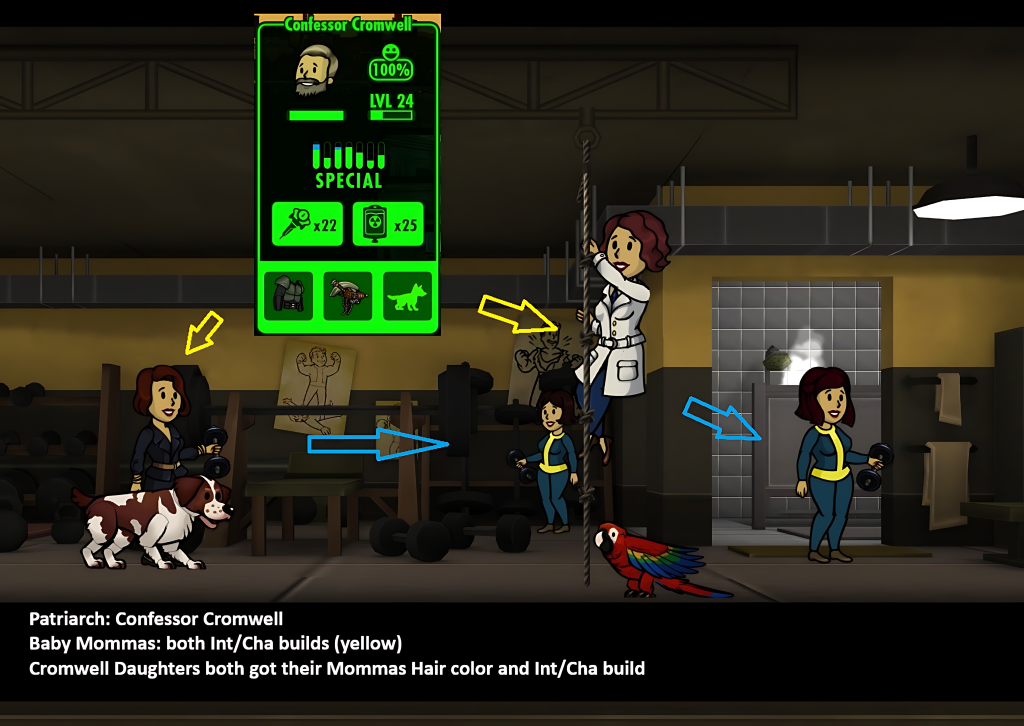
A few more litters in and the clean split I wrote about above isn’t holding. Same patriarchs. Same baby mommas. No new blood in the pool. And the newer kids aren’t coming out like their older siblings.
Cromwell started throwing daughters. Didn’t happen once in the first batch. These daughters got their baby momma’s hair color instead of Cromwell’s, and an Int/Cha lean instead of the Strength build the whole house was supposedly built on. Lyons flipped the other way, more sons showing up, silver hair actually showing up more not less, but the SPECIAL spread stopped sitting neatly in Int/Cha/Luck and started rounding out.
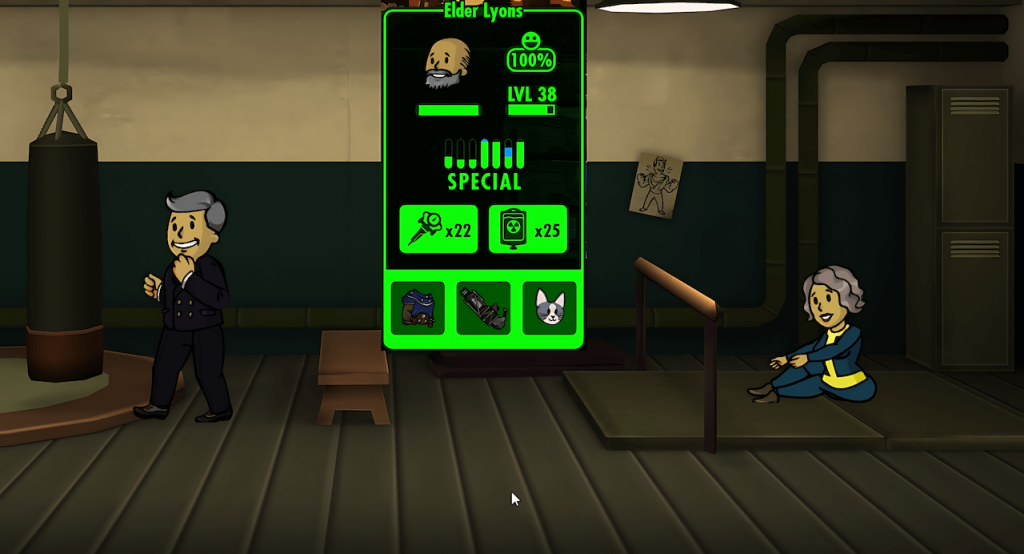
First thing I thought was something changed. New strain, some kind of drift, whatever. But it’s the same pairing. Same baby momma, same dad, different kid. So the boring explanation is probably the real one: neither patriarch was ever a one-stat guy to begin with. Cromwell’s actually rounded across the board. Elder Lyons leans Int/Cha but he’s sitting at 4 to 5 in Strength and Agility too. The “house identity” I was so confident about wasn’t a locked bloodline trait, it was just whichever stat happened to show up first in enough kids in a row that it looked like a rule.
So no, the houses were never as clean as I made them sound in the last post. Cromwell was never just muscle. Lyons was never just a scribe. What looked like two genetically separate dynasties might just be two well-rounded parents whose kids are finally sampling the rest of the sheet instead of the one stat that happened to dominate early.
Which honestly is more interesting than the tidy version was. A breeding program’s supposed to get more predictable with more data, not less. Mine’s doing the opposite.
Or at least that’s what I thought, until I tried to actually test it on purpose.
Update: The Nepo Baby Theory Was Wrong
I bred Lucy, a genuinely high stat dweller, with both Cromwell and Lyons separately, thinking two great parents equals a great kid. The nepo baby theory. Elite parents, elite kid, guaranteed.
Both pairings produced shitty kids. Not underwhelming. Shitty. The best pairing available in my entire vault, twice, failed twice.
Meanwhile the baby mommas I wasn’t even paying attention to did something Lucy couldn’t. Cromwell and the baby momma in the screenshot above produced daughters, a first for the house. Got their mother’s hair color and a stat spread that’s now Str/Agi plus Int/Cha, an actual blend, not a copy of either parent.
Lyons kids are throwing the exact same Str/Agi plus Int/Cha blend now. Same milestone. Except every single one of them still has that same silver hair every Lyons kid has ever had. Not the baby momma’s hair. Not a break. Silver, every time. Like wtf.
So the nepo baby theory failed twice in the vault’s best pairing, and two of the least remarkable baby mommas I had just quietly produced the first real multi-stat kids of the whole program, one breaking hair color completely and one refusing to break it at all. That’s not genetics. That’s not even a pattern I can call a pattern. It’s RNG wearing a family tree as a costume, and it does not care how good your parents look on paper.
Turns out there’s actually a pattern with the normal breeding, just not the one I expected. One high stat on the parent, paired with a normal baby momma, gets you a slightly average kid. Two high stats on the parent, same normal baby momma, gets you a slightly average kid with one stat sitting a bit higher than it should. Three or more high stats on the parent, and you actually get an above average kid, multiple stats running higher than normal. That part’s consistent enough to call a real pattern.
But pair two parents who are both stacked with 3 or more high stats, like Lucy and Cromwell, or Lucy and Lyons, and the whole thing stops being a pattern and turns into a coin flip. You either get a nepo baby, stacked, favored, born on third base, or you get a shitty kid, and there is no reliable in-between. That’s the part that broke my brain a little. More good stats on both sides should mean better odds. Instead it just means bigger stakes on the same dumb coin flip.
Which finally means I get to say it. Listen here, you little shit. You had two elite parents and this is what you gave me.
Update: The Odds Aren’t Zero, I Just Got Unlucky
Before anyone tells me I’m overreacting to two bad rolls, let’s actually talk about odds instead of vibes.
Normal baby momma paired with a normal dad, chances of getting anything worth calling a super dweller are low. Realistically that’s maybe 1 out of every 10 childbirths, and the other 9 are just fine, forgettable, filler dwellers doing filler jobs. That’s the baseline every vault runs on whether you notice it or not.
Now stack two parents who are both loaded, 3 plus high stats each, like Lucy and Cromwell, or Lucy and Lyons. I’d put that closer to 50 to 70 percent odds of getting a standout kid. Genuinely good odds. Not guaranteed, but good.
Which means what actually happened isn’t proof the system doesn’t reward good breeding. It’s proof I rolled bad twice in what should’ve been a coinflip-or-better situation. Elite parents didn’t fail me. I failed the dice. There’s a real difference between “the odds were never good” and “the odds were good and I still lost,” and I was too annoyed in the moment to make that distinction.
Doesn’t change the nepo baby line. It just means the nepo baby line was still a fair bet, I just lost it twice in a row.