Game of Thrones Kingsroad is the kind of game you approach with your guard up. The IP has been stripped down and reskinned enough times that the trailer quality stopped meaning anything. Impressive cinematic, recognizable characters, a title you recognize from something you actually loved, and underneath it a gacha loop dressed in borrowed clothes. That is the pattern. I came into this expecting the pattern. What changed my read on Kingsroad was not the game title or the production value of the marketing. It was the studio behind it.
I covered the pre-registration phase before the launch window hit, flagging the right questions: will progression be fair, will the mobile version feel reduced, will the writing earn back any goodwill after the show’s final seasons. I have answers now. Most of them are better than expected.
Setup Takes One Annoying Session, Then Gets Out of the Way
The first-time setup takes longer than you expect from a game that otherwise moves like a native title. Device registration requires email verification. You are linking platforms, and that process has real friction. It is a one-time cost, but it is worth flagging because players who hit it cold might think something is broken when it is just the onboarding flow doing its job.
Once that initial session is done, launching the game on either device is fast. No sync ritual, no cross-platform handshake that adds loading time. It fires up like any normal game. I started on mobile, picked it up on PC later, and the progress was there. Character, inventory, story position, all of it. Cross-progression in Kingsroad is not a marketing claim with fine print. It works cleanly, and once it is set up, you stop thinking about it.
Mobile: Excellent Haptics, Honest Control Jank
The mobile experience is not equal to PC, and it is worth being specific about where it falls short and where it does not. The controls feel janky. Touch inputs for an open-world RPG work well enough for traversal and menu navigation, but combat has a looseness to it that you feel during every encounter. If you have access to a PC, use it for combat-heavy sessions.
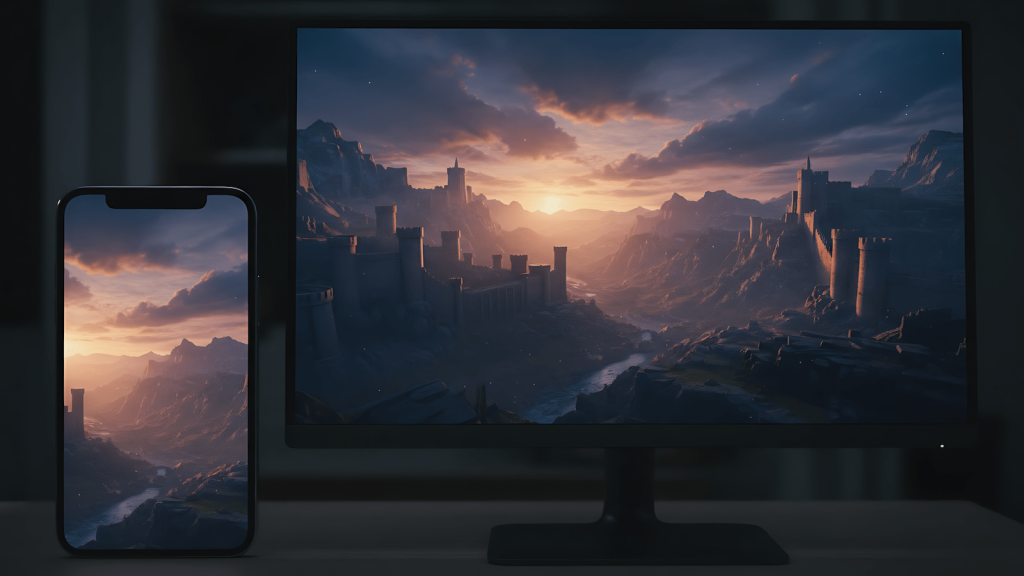
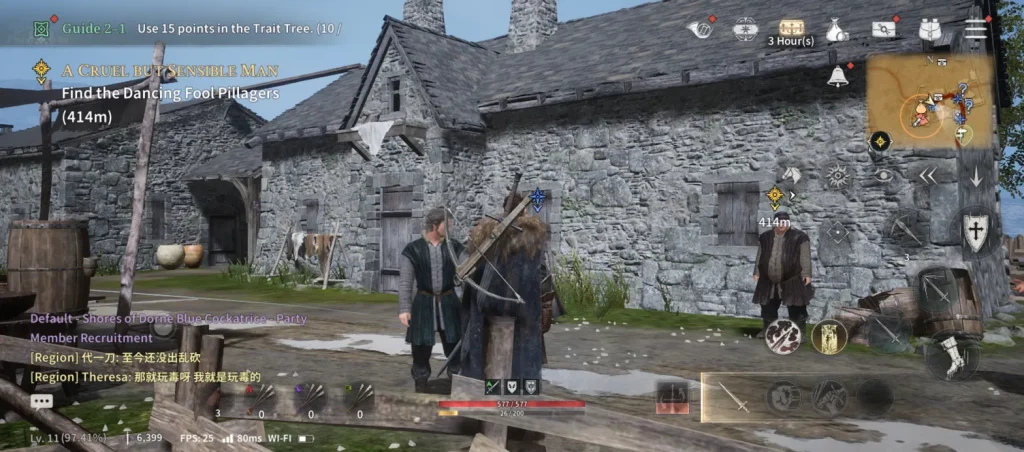
What Netmarble gets right on mobile is the haptic feedback. The touch response is excellent, the kind of polish you expect from a studio that has been building mobile titles at this level for years. The game knows it is running on a phone and it uses that. The feedback layer makes the experience feel deliberate rather than ported. I cast it to my TV before I moved to PC, because it is technically a mobile game and that felt like the natural test. On a big screen it already looked better than expected. That gap widened considerably when I got to the PC version.
The FPS counter on screen reads 25 and means nothing. The game plays smooth. If you are the type to screenshot the counter and write off the experience, do not. What you feel while playing does not match what that number implies.
PC: This Is What the Game Actually Is
On PC with an i7-8700 and a GTX 1660, Kingsroad performs and feels like a real triple-A game. Not “good for a mobile game running on PC.” A real PC game. The performance holds, the visuals resolve at a level the phone screen was compressing, and the control precision that the mobile version is missing is fully present. The environments in Westeros, the draw distances, the detail in keeps and strongholds, these land differently when you are not squinting at them on a 6-inch display.
The GTX 1660 is not a new card. Kingsroad running well on that hardware is part of what makes the AAA-on-mobile framing accurate. The game is doing more with its visual budget than the minimum specs suggest it should be able to. It looks like something that should require more, and it does not. That is an engineering decision worth noting.
The transition between devices does not show in your progress or your feel for the game. You do not arrive on PC and find a better version of your character. You find the same character in a better-looking world with better inputs. That is the correct implementation of cross-progression, and it is what separates a feature that works from one that is just listed on the store page.
You Are Tied to the Story, Not the Hero
This is the design decision that separates Kingsroad from the standard open-world RPG template, and it is the right call for this IP. You are not Jon Snow. You are not Daenerys. You play as an heir to a fallen house, choosing from three classes that fit naturally into the margins of Westeros: a Knight, a Sellsword, and an Assassin. These are not arbitrary archetypes bolted onto a fantasy game. These are exactly the kinds of people who would exist in the cracks of that story, close enough to the action to matter, anonymous enough not to break the canon.
The main cast is present. The major beats are around you. You move through locations that carry the weight of the show’s timeline. Winterfell during the Bolton occupation is not background decoration. It is environmental storytelling that only works if the writers actually knew what happened there and built the space around it deliberately. That level of care shows up consistently, and it is what separates a game that uses an IP from a game that understands one.
Your narrative is adjacent and personal. You are a participant in the story, not its replacement. Games that drop a custom character into a beloved story and ask you to pretend the original protagonist does not exist create a dissonance that never fully resolves. Kingsroad sidesteps that by being honest about your role. It gives you stakes without stealing the IP’s. For anyone who watched the show and cared about the world rather than just the spectacle, this structure is more satisfying than being handed a sword and told you are the chosen one. The fallen house premise sidesteps the most divisive canonical moments while using the world’s full infrastructure. That is a smart structural decision and the story earns it.
The Honest Verdict
The thing that makes Kingsroad work is not the Game of Thrones license. Plenty of games have had that license and done nothing with it. What makes it work is that Netmarble built an actual game first and put the IP on something that could carry it. The cross-progression is clean because the infrastructure was engineered properly. The visuals hold on a GTX 1660 because the performance budget was managed honestly. The story structure respects the source material because someone made a deliberate decision not to cannibalize it. None of that comes from owning the rights to Westeros. It comes from a studio that treated the license as a responsibility rather than a shortcut.
Other studios should be studying this format. You do not need a beefy PC to play Kingsroad because the game was designed mobile-first and scaled up, not the other way around. Cross-progression means the platform you own right now is already enough to start. Yes, there are in-app purchases. That is expected from a free mobile game with full PC cross-play. The trade you are making is a fair one: a triple-A game at no entry cost, with optional purchases for players who want to go deeper. That is not a gotcha. That is the model working correctly.
That is not the norm for IP-driven mobile games. If you want to see what the norm looks like, the Solo Leveling Arise review on this site covers a game that had the same opportunity and did less with it. Kingsroad is the other outcome. If you are running a multi-platform setup and want something that genuinely uses both devices rather than treating one as a fallback, this is a rare case where that actually works. It is worth saying out loud when it happens.