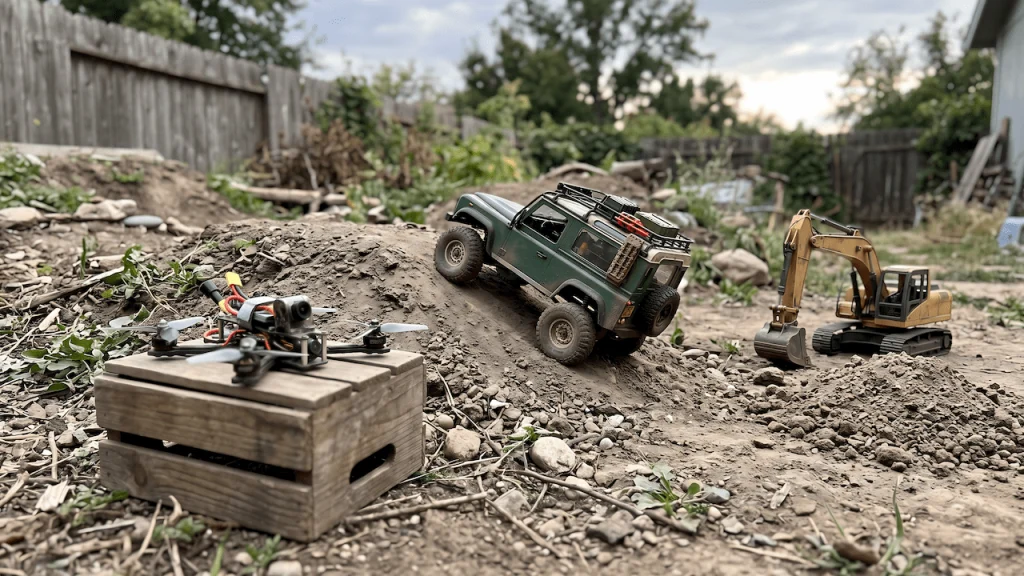
I have never needed a track. I run my RC vehicles on my own, in my own backyard, on a course I build and rebuild whenever I get bored of the last one. If that sounds like your kind of Saturday, this guide is for you, and it is not a gift list for kids. It covers remote control cars, drift cars, rock crawlers, jump trucks, mini drones, and the construction vehicles I could happily lose a whole afternoon to: excavators, dump trucks, cranes and loaders.
Some links on this page are Amazon affiliate links. If you choose to buy through them, HobbyEngineered may earn a small commission at no extra cost to you.
These links only appear where tools or everyday support items naturally fit the topic. No sponsored placements. No hype.
Quick picks if you want to skip ahead:
- Best 1/10 scale crawler: Traxxas TRX-4 Land Rover Defender
- Best small crawler for a backyard: Axial SCX24 Base Camp
- Best mini drone to start with: DJI Mini 4K
- Best RC Batman Tumbler for building and driving: LEGO Technic Batmobile Tumbler 42239
| Pick | Type | Key spec | Honest take |
|---|---|---|---|
| Traxxas TRX-4 Land Rover Defender | 1/10 crawler | Full time 4WD, portal axles, two speed transmission with remote shifting, locking differentials | The one I wanted. Fully assembled, but battery and charger are sold separately |
| Axial SCX24 Base Camp | 1/24 crawler | 4WD, about 225 mm long, radio, battery and charger in the box | Small enough to run on a desk or a dirt patch, and it is ready to drive out of the box |
| DJI Mini 4K | Mini drone | 249 g, 4K video at 30 fps, claimed 31 minute flight time | Sits right at the 250 gram line that matters for registration, with downward sensors only |
| LEGO Technic Batmobile Tumbler 42239 | Build and drive | App controlled through CONTROL+, lights and a boost feature | You build it, then you drive it. It is a build set first and an RC car second |
Why hobby grade RC cars beat anything in the toy aisle
Hobby grade is a different animal. Real suspension, real drivetrains, parts you can replace and upgrade, and a radio that does not feel like a TV remote from a gas station. That is the whole difference between a toy you drive for a week and a vehicle you keep tuning for years.
For me it comes down to one thing: remote control cars let you play at a scale where the world is your course. A pile of dirt becomes a hill climb. A drainage ditch becomes a river crossing. I do not look for RC tracks, because I would rather build my own. Nobody schedules me, nobody is waiting behind me, and nobody cares if I spend two hours failing the same climb.
The scale matters too. The bigger the vehicle, the more it costs and the more space it wants. The smaller the vehicle, the more places you can run it. I will get into that choice below, because it is exactly where I landed with my own Defender.
Best RC rock crawlers: the Defender, the Humvee I skipped and the one I own
If there is one part of this hobby I would point a beginner toward first, it is the RC rock crawler. A crawler is built for slow, careful control over rough ground. You are not chasing speed. You are solving a problem with a vehicle, one obstacle at a time.
I have wanted the 1/10 scale Land Rover Defender for a long time. The one I own is a 1/24 Defender 110. I always wanted the 1/10 hobbyist version, but it was too expensive for me, so I made peace with the smaller one and it is still very much mine. I also looked hard at a 1/10 Humvee, and the price made me walk away. That is the honest tradeoff with crawlers: the bigger and more detailed the scale model, the faster the cost climbs.
Traxxas TRX-4 Land Rover Defender (1/10)
This is the benchmark if you want a Defender at hobbyist scale. It runs full time 4WD with portal axles, which lift the axle housings higher for more ground clearance. The two speed transmission has remote high and low range, and the differentials lock by remote, which is what you want when one wheel is hanging in the air. The electronics include a waterproof ESC, so a wet backyard is not a problem. It arrives fully assembled, with the painted Defender body already on. The thing to plan for is power: you need to buy a compatible battery and a charger separately.
If the 1/10 is out of reach, this is the size class I live in. The SCX24 is a 4WD 1/24 crawler about 225 mm long and a little over 100 mm wide. It ships with the radio, the ESC, a small LiPo battery and a USB charger in the box, so you are driving on day one. At this size you can build a course on a coffee table, which is exactly why small crawlers have exploded. The tradeoff is simple: tiny scale means tiny obstacles, and it will not walk over what the TRX-4 shrugs off. Note that the Base Camp is not a Defender body, so if you are set on a specific shell, check what is available for the platform.
A remote control Hummer or Humvee crawler is the obvious dream pick, and a big 1/10 Humvee is a stunning machine, but I found the price hard to justify as a backyard vehicle. If the shape is what you love, an RC Hummer H1 style body is worth shopping around for, and it is smart to compare what you get in the box before you commit.
Best RC drift cars
An RC drift car is the opposite of a crawler. You want a smooth, flat surface, hard tires and a car that slides on purpose. The trick is the setup. Look for a rear wheel drive or a drift tuned AWD chassis, hard plastic drift tires, and a gyro if you want help holding long, controlled slides. Without those three things you are just driving a car that spins out.
Smooth concrete, a garage floor or a patio all work. Because drift cars run on flat ground, they are the easiest vehicles in this guide to run at home without building anything.
If you like building, a kit is a better way in than a ready to run box, because you learn what every part does. A Tamiya TT-02 chassis is a common starting point in this world. Check which version you are buying, because drift specific chassis and standard racing chassis are not the same thing.
Best RC stunt cars and monster trucks for jumps
Jumping is where the backyard turns into a stunt park. A dirt ramp, a wooden board over a few bricks, anything that gets the wheels off the ground. The vehicles that handle it are trucks with long travel suspension, strong 4WD, and parts that can take a landing.
An RC monster truck can mean anything from a cheap basher to a serious machine. The names that keep coming up are Traxxas models like the Slash, the X Maxx and the XRT, which are popular enough that replacement parts are easy to find. I have not run these myself, so treat them as the starting names to research, not a ranking. Whatever you pick, a few rules hold. Buy a truck that says it is 4WD if you want to launch and land well. Check the parts availability before you buy, because you will break something. And keep a repair mindset: if you enjoy fixing things, my gunpla repair tools guide covers the small tools you will end up using on RC trucks too.
Best mini drones and FPV drones for beginners
Drones are the other half of this hobby. A mini drone gives you a point of view you can never get from the ground, and it packs into a small bag.
For a first drone, the DJI Mini 4K is a sensible pick. It weighs 249 g, shoots 4K video at 30 fps, and DJI claims a 31 minute flight time. It uses downward sensors only, which help with landing but do not stop you from flying into a tree. That matters, because it means you still have to fly it like a pilot. The weight is the other reason people choose this class. 249 g sits just under the 250 gram line that decides registration in the United States, which I cover in the next section.
If you want a step up, the DJI Mini 4 Pro is the one everybody searches next. I have not verified its specs for this guide, so check the current listing before you decide.
FPV drones are a different thing. You fly using goggles, so you see what the drone sees. It is thrilling and it is harder, so start on a simple mini drone before you move to a quadcopter you have to build and tune.
Drone license and registration rules: the United States and the Philippines
You may have heard that you need a license to fly a drone now. For most hobby flying, that is not quite right. Here is what applies, based on what the FAA and CAAP publish.
United States (FAA)
- Recreational flyers do not need a pilot license. They do need to pass the free online TRUST test and carry proof of completion while flying.
- Drones weighing 250 grams or more must be registered, and the registration number goes on the outside of the drone. Registered drones also need to broadcast Remote ID, unless they are flown inside an FAA recognized identification area.
- Recreational flyers are also expected to follow the safety guidelines of an FAA recognized community based organization.
- Flying for business or revenue falls under a different set of rules (Part 107), with its own registration.
Philippines (CAAP)
- CAAP’s published table says drones flown for sport or recreation under 7 kg do not need registration, a controller certificate or an operator certificate.
- A special flight permit is still required for night flights, flights beyond visual line of sight, flights within 10 km of an aerodrome reference point, flights over populated areas, and flights above 400 feet.
- Commercial flying needs registration, a controller certificate, an operator certificate and a special flight permit.
- One source I checked says much of Metro Manila falls inside that 10 km airport zone. I could not confirm that from CAAP directly, so check your exact location with CAAP before you fly.
Rules change, so confirm everything on the FAA and CAAP sites before you fly. The point is that for a small hobby drone, the real obligations are registration where it applies, a safety test in the US, and permits near airports and crowds.
RC excavators, dump trucks, cranes and loaders: build your own track
This is the section I could write all day. Give me a loader or an excavator and I will happily disappear for hours. Who would not want their own digger in the backyard to play with?
The idea is simple and it changes the whole hobby. Instead of looking for a track, build one. An RC excavator moves dirt. An RC dump truck hauls it. A loader pushes it around. Put them together and you are shaping a course for your crawler to roam through. I do not own these yet, but the excavator and dump truck are next on my list, so my Defender has somewhere to go.
What to look for, by vehicle:
- RC excavators. A remote control excavator is the one I want most, and the thing to check is whether it actually digs. Some are display toys that only wiggle, and others have a real bucket that moves material. Look at the bucket and the arm material before you buy.
- RC dump trucks. A dump truck with a working bed pairs perfectly with an excavator. Brands like Huina and licensed CAT models come up often in searches. Check that the bed tips under power and that it can carry real material.
- RC cranes. Look for a crane with a real boom and winch, and check how much it can lift before it tips.
- RC loaders and skid steers. A skid steer or wheel loader is the best tool for moving sand and gravel around a course. Check bucket size and whether it is built for dirt or only for carpet.
I have not verified specs on these specific models for this guide, so check each listing for what it can actually move before you buy.
If you want a place to start designing the course itself, my post on tabletop terrain from household materials has cheap ideas for obstacles that scale up to the backyard.
The RC Batman Tumbler: two ways to get one
I have wanted the Batman Tumbler for a long time. What I mostly see are LEGO Technic sets and scale display models, so I went looking for a true RC version. There are three tiers.
- Mass market RC. A 1:15 scale Tumbler RC with a 2.4GHz remote control, sold as an all terrain model that can handle snow, mud, rocks and grass. That claim comes from the seller, so test it on rough ground before you rely on it.
- LEGO Technic. The Batmobile Tumbler 42239 is a remote controlled build. You assemble it, then drive it through the CONTROL+ app, with steering, lights and a boost feature. If you already like Technic, my LEGO Technic post is the place to see why I like the line.
Author’s Picks
Five I would put in front of a hobbyist, from the practical to the personal.
- Tamiya TT-02 Toyota GR 86 kit. A 1/10 scale 4WD shaft driven assembly kit. You build it yourself, and the ESC, radio, battery and charger are all sold separately. Best if you like to know what every part does.
- DJI Mini 4K. The easiest way into flying: 249 g, 4K video, and nothing to build.
- Batmobile Tumbler RC 1:15. The easiest way to get a driving Tumbler onto rough ground.
- Axial SCX24 Base Camp. The small crawler that proves you do not need a big budget to start.
- Traxxas TRX-4 Land Rover Defender. The one I keep looking at.
The bottom line
Pick the vehicle that matches how you want to play. Want to solve problems slowly? Crawl. Want to slide? Drift. Want air? Jump. Want to see the world from above? Fly, and learn the rules first. And if, like me, you would rather build your own track than drive someone else’s, start with a crawler and add a digger. If you are not sure where to begin, the TRX-4 Defender and the SCX24 Base Camp are the two I would open first.