No PS5. No Series X. PC is the only platform in the house, and it has been for a while. Mouse and keyboard is still correct for most of what I play, RTS included, no controller has ever changed that, no controller ever will. But “best controller for PC gaming” was never one answer. It depends entirely on what’s actually running, and I keep three in rotation depending on the game, plus a couple more worth knowing about even though I haven’t run them myself.
Some links on this page are Amazon affiliate links. If you choose to buy through them, HobbyEngineered may earn a small commission at no extra cost to you.
These links only appear where tools or everyday support items naturally fit the topic. No sponsored placements. No hype.
Controller for Deliberate Third-Person and Cover Shooters
Ghost Recon Wildlands, Division 2, Spider-Man 2, Resident Evil: Requiem, all paced for patience over reflex, all built around positioning instead of flick-shot precision. For these, the Xbox Wireless Controller is what I reach for. Windows recognizes it through XInput the instant it’s plugged in or paired, no driver hunting, no third-party software standing between me and just playing. That matters more than it sounds like it should, because most third-party pads on PC still run through a generic HID protocol that needs a mapping layer like DS4Windows or Steam Input to behave correctly in games that expect an Xbox-style input signature. Xbox controllers skip that step entirely, which is the actual reason it’s the one I grab without thinking.
Aim assist does real work in games like these, tightening a reticle onto a target that’s already mostly lined up, because the pace is already slow enough for that to matter. It’s not fixing precision, it’s matching a pace where precision was never the point. In a cover shooter, you’re posted up, reading an angle, deciding when to peek, and the stick only has to get you close before assist finishes the job. That’s a completely different task than tracking a strafing target at range, which is exactly the scenario where controller aim falls apart and mouse wins outright.
If you want something built for PC specifically rather than a console controller adapted to it, the GameSir G7 SE is worth knowing about. Wired plug and play for Windows, Hall Effect sticks and triggers standard, no drift concerns from day one. I haven’t run one myself, so I’m not vouching for the feel of it, but on spec alone it solves the same drift problem the Xbox pad eventually runs into, at a similar price point, and being wired removes any latency argument entirely.
Controller for Games That Actually Use PS5 Style Haptics
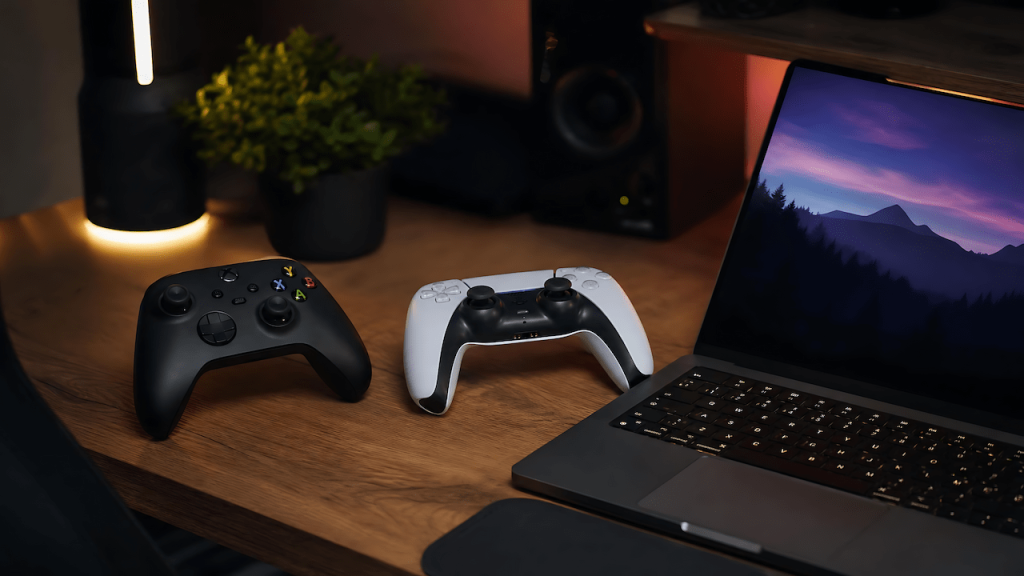
Some PC ports still carry DualSense’s adaptive triggers and haptic feedback over USB, muted compared to a real PS5 but genuinely present. For those specific titles, the DualSense is worth switching to on purpose, not as a default, because the feedback is doing something the Xbox pad can’t replicate. The adaptive triggers add real resistance depending on what’s happening in game, a drawn bowstring, a jammed weapon, a car losing traction, and that’s not something software can fake on a controller that wasn’t built for it. Outside of games that actually use it, there’s no reason to reach for it over the Xbox controller sitting right next to it, since the rest of the experience is functionally the same and Windows handles it less natively than an Xbox pad.
Controller for Casual, Low Stakes Sessions
Not every session needs the good controller. A wired 8BitDo covers the nights where battery level or whether the controller survives getting knocked off the couch isn’t worth thinking about. Hall Effect sticks mean drift isn’t a concern even at the low price, which is the actual reason it earns a spot here, not because it happens to be cheap. Standard controller sticks use physical potentiometers that wear down with friction over time, which is exactly why old pads start drifting after a year or two of regular use. Hall Effect sticks read position magnetically instead, no physical contact, no wear, so a budget controller with that spec inside it holds up longer than a premium controller without it.
For the lowest price point that still holds up, the Logitech F310 is a plain wired pad, no Hall Effect sticks, no wireless, nothing extra. That’s the point of it. If all you need is something that registers inputs reliably without paying for features you won’t use, this is what that looks like stripped down to the studs, and it’s been a reliable plug and play option for long enough that it’s not a gamble the way a no-name brand would be.
Flight Stick and Wheel Options for PC, When You’re Ready
Neither genre needs expensive gear to find out if it’s worth pursuing. A basic single flight stick in the entry price range is enough to know if a flight sim earns permanent desk space, no need to jump straight into a full HOTAS with rudder pedals before you’ve logged real hours on something simpler. An entry level wheel and pedal set does the same job for racing sims, well before a direct-drive setup and load-cell brake are worth the money. Start cheap, confirm it actually sticks, upgrade only once that’s proven, the same rule I apply to any new hobby before sinking real money into it.
Bottom Line: The Right Controller for PC Gaming Depends on the Genre
The genre decides the controller, not a ranked list. Xbox or a PC-native pad like the G7 SE for deliberate shooters, DualSense for the specific games that use it, 8BitDo or the F310 when it doesn’t need to matter at all. That’s the actual framework, and it’s the one sitting next to my desk right now.