Papercraft has no limit but your imagination. If you’ve got a screenshot, a promo render, a frame grab from a movie, or just a clear picture in your head, that’s enough to build it. No manufacturer decides what gets made. No production run decides whether it’s worth tooling. If you can see it, you can fold it.
That’s the actual pitch behind figuring out how to get into papercraft models, and it’s not a metaphor. A plastic kit exists because a company ran the numbers and decided enough people would buy it. A papercraft build exists because you decided to make it. Those are two completely different starting points, and once that clicks, the whole hobby looks different. You’re not standing in front of a shelf hoping someone made what you want. You’re building the thing you already have in your head.
What That Actually Means in Practice
This isn’t about avoiding stores or proving a point about manufacturers. It’s just what’s true about the craft. Whatever’s on your list, an Apache, a Comanche, a Chinook, a Humvee, an Abrams, the Halo Scorpion, the Highwayman, the Interceptor, none of that requires anyone’s permission or product decision. You go from an image to something you built with a blade, cardstock, and glue. The gap between “I want this” and “I’m building this” is a lot shorter than it looks from the outside.
Two Ways In, and Neither Is About Getting It Right Immediately
There are two real paths into this, and picking one isn’t a commitment, it’s just where you start.
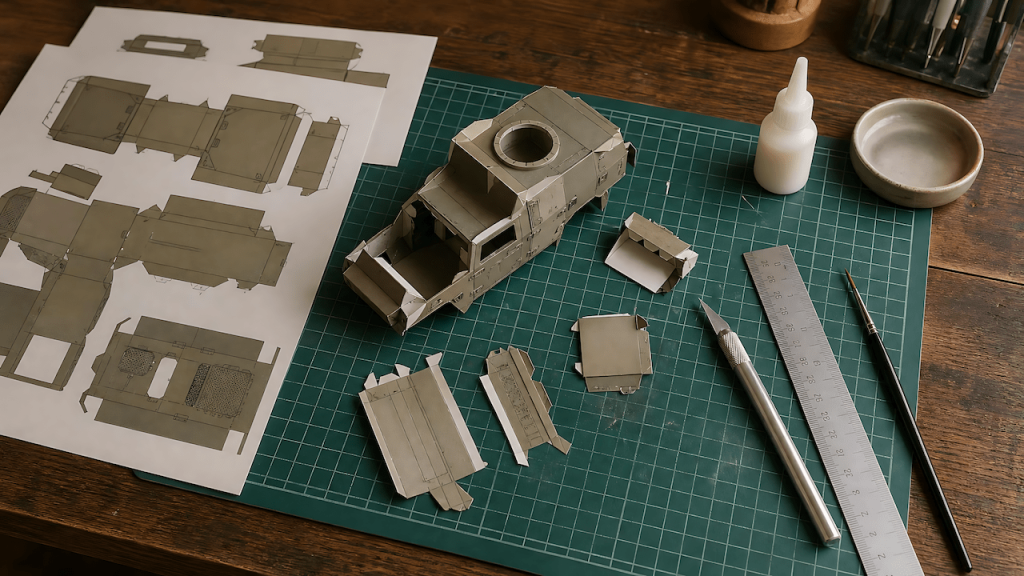
The first is designing or finding a 3D model and unfolding it into a flat, printable template using software like Pepakura Designer. You take a mesh, the software slices it into panels with fold lines and tab numbers, you print it, and you’re working from a pattern that tells you exactly where every cut and crease goes.
The second is skipping all of that and going hands-on. No software, no template, just cardstock, a reference image, and a blade. You’re eyeballing proportions, cutting freeform, folding by feel, and correcting as you go.
Neither path is the correct one. The templated route gets you accuracy faster because someone already solved the geometry problem for you. The freeform route builds instinct faster because you’re the one solving it, badly, over and over, until you’re not. Every clean template you find online, every builder whose work looks effortless, came from someone who ruined a dozen sheets first. This is closer to a craft than a kit. Your first few builds are going to look rough no matter which path you take, and that’s the tuition, not a sign you picked the wrong hobby.
Where the Models Come From
If you’re going the templated route, you’ve got two options. Plenty of subjects already have templates floating around from other builders, scattered across niche forums and file-sharing sites, not always in English, not always easy to find, but they’re out there. When nothing exists for what you want, you can get one made. Services exist that take your own 3D model, or even help you source one, and unfold it into a custom Pepakura file built to your specs. That’s the option that matters most for anything obscure, a specific game vehicle, a specific movie-era design, something with a small enough fanbase that nobody’s bothered making a template yet.
Some links on this page are Amazon affiliate links. If you choose to buy through them, HobbyEngineered may earn a small commission at no extra cost to you.
These links only appear where tools or everyday support items naturally fit the topic. No sponsored placements. No hype.
Scale Is Yours to Decide
Nobody sets the scale for you unless you’re working from someone else’s finished template. Design or commission your own file and you pick the number. That means your Valkyrie doesn’t have to match a 1/72 scale toy line, and your SDF-1 can be as big as your desk allows, because the only thing deciding its size is you.
The Part That Actually Gets Hard, and Stays Hard for a While
Two problems show up early and don’t fully go away.
The first is color. Pre-colored cardstock works fine for flat panels and simple color blocking. When a build needs paint, acrylic and gouache are the ones that actually work on paper. Watercolor is too wet and will warp cardstock even at heavier weights, and oil is too heavy unless it’s thinned first, both risk bowing a panel that was flat five minutes earlier. A detail brush handles small panels and touch-ups fine. An airbrush or spray paint earns its keep on large flat surfaces, applied in thin coats, never one heavy pass. A lot of builders prime with diluted PVA glue or a gesso coat first, sprayed rather than brushed, so the color doesn’t soak in unevenly or smear the printed lines underneath. If you want a piece to survive real handling, synthetic paper, the same plastic-coated stock used for waterproof menus and tags, prints and folds like cardstock but resists tearing and moisture the way plastic does. It’s still papercraft, just a material upgrade for a build that needs to hold up.
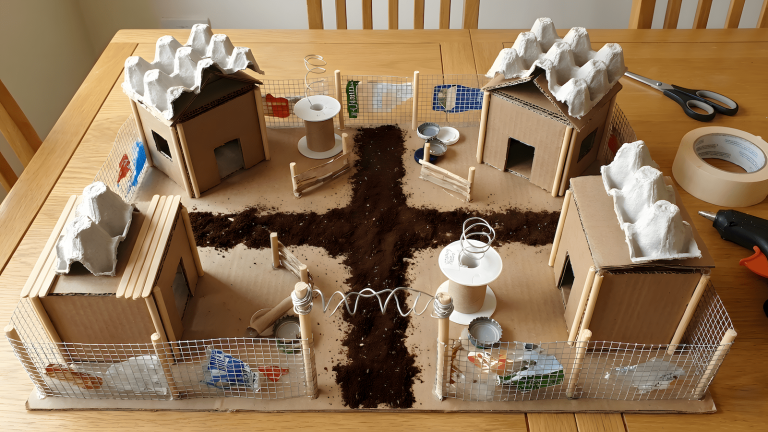
The second is anything round or compound-curved, tires, gun barrels, rotor housings, canopies, the weird transitional angle where a wing root meets a fuselage. Flat paper does not want to become a smooth curve, and it fights you the whole way there. This is where backing, layering, and reinforcement start to matter, sometimes cardboard behind a stress point, sometimes multiple thin layers curved and glued in stages instead of one sheet forced into a shape it doesn’t want. It’s the same problem you run into shaping household materials into tabletop terrain that has to hold a curve and survive being handled, and the fixes aren’t that different. If you’ve already fought a version of this on a Gunpla build, the instinct transfers, though paper punishes overconfidence a lot faster than styrene does.
What You Actually Need to Start
A printer if you’re working from templates, cardstock in a workable weight, a sharp hobby knife, a metal ruler, a self-healing cutting mat, PVA glue, and acrylic or gouache paint if the build calls for it. If you’re going the templated route, add the unfolding software itself to that list. None of this is expensive or hard to find, and most of it overlaps with what you’d already have on hand if you’ve built anything else with your hands before.
Bottom Line
None of this is about the list. The Apache, the Abrams, the Tumbler, the Batwing, the Scorpion, none of it exists yet, and that’s fine, because the list was never the point. It’s proof of how wide the door actually is once you stop waiting on a manufacturer to decide what’s worth making. What matters is picking up a blade and a sheet of cardstock and starting, badly, on whatever’s first. The craft is the point. Whatever convinced you to start, a screenshot, a memory, a shelf you wish existed, that’s just the reason you walked through the door.