If you have spent any time in PC gaming communities online, you have probably seen the strong consensus that building your own PC is the only real way to do it, and that prebuilts are overpriced traps for people who do not know better. That framing is wrong, and it is wrong in a way that costs real people real money because it pushes them toward decisions that do not fit their actual situation.
The gaming PC vs prebuilt conversation sounds like a technical debate. It is mostly a marketing problem. Both options produce a PC. Both run the same games at the same settings given equivalent hardware. The word “gaming” printed on a box, a component, or a store listing is primarily a pricing signal. It tells you the seller knows their audience and has adjusted the number accordingly. It does not guarantee better performance than an equivalently spec’ced machine without the label.
What a Prebuilt Actually Is
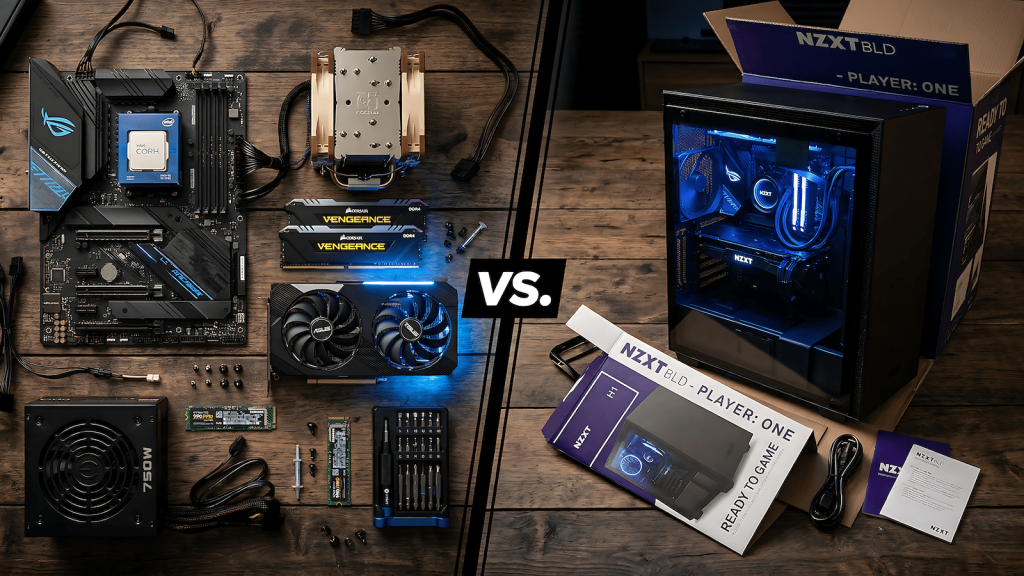
A prebuilt gaming PC is a system that someone else assembled for you before you bought it. The store sourced the parts, put them together, and tested the system. You pay for that convenience. The stigma around prebuilts comes from a real pattern: some manufacturers use this setup to push weaker PSUs, pair strong CPUs with underpowered GPUs, or load the machine with bloatware that eats resources. Those are legitimate criticisms of bad prebuilts, not of prebuilts as a category.
The problem is that the criticism got generalized. Not every prebuilt is a bad prebuilt. Local computer stores, in particular, often build systems that are genuinely competitive in price because they are not operating under the same margins or marketing budgets as a major retailer. If you walk into a shop and look at what they are offering at a given price point, you might find that their assembled system is within a few thousand pesos of what you would spend building the same thing yourself, without accounting for your time.
Where Custom Builds Actually Win
Building your own PC does give you real advantages in specific situations. You control every single part selection, which means you can optimize for your actual workload instead of accepting whatever the manufacturer thought was a reasonable configuration. That extends to decisions most people do not think about upfront, like better airflow, which becomes a real factor once you are pushing the system harder or planning to run it for several years. You understand your system intimately, which makes upgrades and troubleshooting easier down the line. And you avoid the risk of a builder cutting corners in ways that are not obvious until something fails.
Custom builds also make more sense if you are building above the midrange. Once you are spending enough that the per-component decisions have significant cost implications, the research investment starts paying off. If you are targeting 1440p at high refresh rates, running memory-heavy workloads alongside gaming, or planning to skip GPU generations strategically rather than upgrade on a fixed schedule, building custom gives you the flexibility to make those calls yourself rather than working around someone else’s defaults.
The honest version of the custom build advantage is this: it rewards people who enjoy the process. If researching parts, comparing benchmarks, and putting the machine together is something you find satisfying, you will probably end up with a better system for your budget because you are willing to put in the hours. If that sounds like a weekend you would rather not spend, the advantage shrinks considerably.
Where Prebuilts Make More Practical Sense
There are real scenarios where buying a prebuilt is the smarter financial decision, and the gaming community does not talk about these enough. The first is time. Sourcing every component yourself takes hours of research, price watching, and compatibility checking. That time has value. If you have a job, kids, limited hours in the week, or just a different way you would rather spend your bandwidth, the convenience of a prebuilt is a legitimate factor, not a lazy excuse.
The second is budget pressure at the lower end. When you are working with a tighter budget, a local store prebuilt at a fixed price point can sometimes beat a self-sourced build because the store is buying components at volume and passing some of that savings on. At around 50,000 pesos, for example, a prebuilt from a reputable local shop can land you a genuinely capable gaming system. Sourcing the same specs independently might come in close, or it might not, depending on what is available and what the current pricing looks like for individual parts.
The third is when your actual use case does not require bleeding-edge specs. If you are gaming at 1080p on titles that are not GPU-intensive, running a modest monitor, and mostly using the machine for gaming plus everyday tasks, you do not need the fine-tuned optimization that a custom build allows. A prebuilt at the right price point will do exactly what you need it to do for the next several years without you having to think about it.
The Hybrid Approach Nobody Talks About Enough
The move that makes the most sense in a lot of real-world situations is treating a prebuilt as a base rather than a final product. Walk into a store, identify a prebuilt that gets you the platform you need, and then ask which parts are swappable. Most local computer stores will accommodate this conversation. You might end up keeping the CPU, motherboard, RAM, storage, and case while swapping in a better PSU and a GPU that fits your actual gaming targets. The store does most of the assembly work, and you only pay for the upgrade delta.
This is how a lot of practical PC purchases actually happen outside of enthusiast forums, and it is a perfectly reasonable way to manage the tradeoff between cost, effort, and outcome. Instead of doubling the price of a prebuilt to go fully custom, you add a fraction of that cost to upgrade the components that actually matter for your use case. The result is a machine built around your priorities without requiring you to source every single part yourself.
Specs, Budget, and Use Case First
The actual question you should be asking is not “prebuilt or custom?” The question is: what do you need the machine to do, what is your real budget, and how much time are you willing to put into the decision? From there, the right path usually becomes clearer on its own.
A single-channel 16GB RAM stick at 2400 MHz running a non-K processor alongside a GTX 1660 can serve you well for years if your gaming habits align with what that hardware can actually handle. The spec sheet does not define your experience. Your use case does. Chasing numbers because a forum told you the minimum acceptable spec is higher than what you actually need is how people overspend on either path.
The Bottom Line
Gaming PCs and prebuilts are both PCs. The debate around which one is legitimate has less to do with hardware and more to do with identity, which is a bad basis for a purchasing decision. Build custom if the process appeals to you, if you are spending enough that part selection matters significantly, or if you have a specific configuration in mind that no prebuilt matches. Buy a prebuilt if the price works, if your time is better spent elsewhere, or if a store can get you most of the way there without the sourcing overhead. And if neither option is perfect on its own, ask the store what they can swap. The answer is often more flexible than you expect.
Nobody talks down to someone for buying a mouse instead of sourcing the switches, shell, and scroll wheel themselves. The people who do build custom mice still complain about wobble and rattle. A PC is the same thing at a larger scale. The ritual of assembly does not guarantee a better machine. It just guarantees more steps.