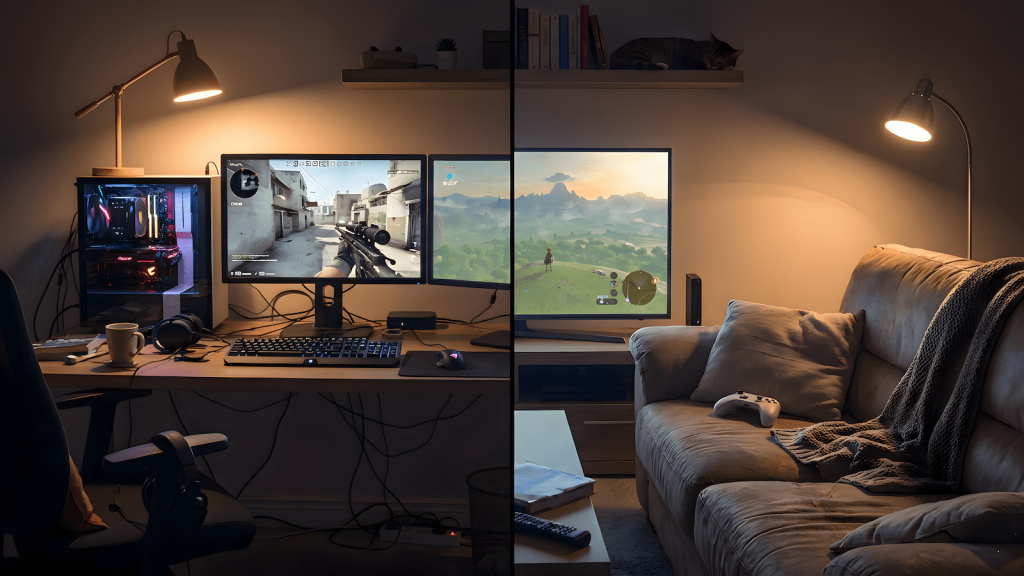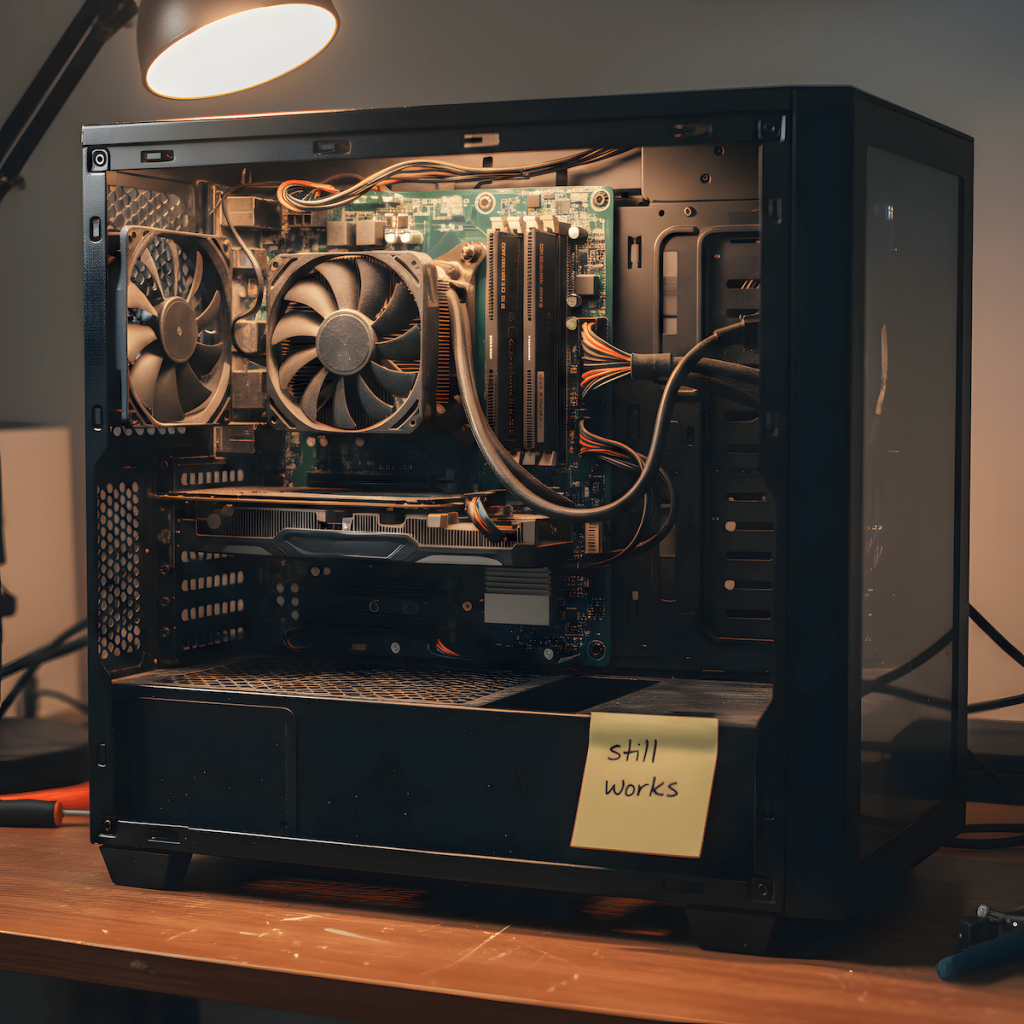
The RTX 2000 series was already six months old when I bought my GTX 1660 in early 2019. I knew the newer generation existed, and I bought the 1660 anyway. Then the 3000 series came. Then the 4000 series. And now the 5000 series is here. I’m still on the 1660, and it wasn’t laziness or budget constraints that kept me here. It was a deliberate systems decision every single time.
Here’s why skipping generations is often the smarter move, and what you actually need to think about when you finally do pull the trigger.
The GPU Isn’t the Whole System
This is what most upgrade guides completely ignore. They benchmark the card, tell you the frames-per-dollar ratio, and stop there. But your GPU doesn’t run alone, and that’s the part nobody talks about.
When I look at upgrading to something like an RTX 3070 or beyond, I’m not just pricing a GPU. I’m looking at the whole chain because the weakest link in that chain is what decides whether the upgrade actually works or quietly backfires on you.
Start with the CPU. My i7-8700 can work alongside a 3070 without embarrassing itself, and that’s a pairing I’ve actually thought through. But if you pair a 1660-era CPU with a 5070 or a 5080, you’re leaving serious performance on the table. More than three or four generations apart and the CPU becomes the real bottleneck, not the GPU you just spent money on.
Then there’s the PSU, which is honestly the part most people underestimate until something goes wrong. I’ve already written about why the power supply is the decision that makes or breaks an upgrade, but in my specific case it’s even more pointed. My current PSU is a 500W unit, sized for the 1660 and the rest of my build as it stands right now. It’s not sized for a 3070, let alone anything in the 5000 series. That means a GPU upgrade isn’t just a GPU purchase. It’s a GPU plus a PSU upgrade to at least 750W, at minimum, and that’s before anything else in the system changes.
Sustained Load Is a Different Problem Than Peak Load
My machine runs 24/7. It’s rarely off. And that changes everything about how I think about power draw.
Most people think about peak wattage, like the spike at boot or the max draw during a benchmark. But sustained load is what actually matters in a system that never sleeps. If my build has been comfortably drawing around 130W sustained for years and I introduce a card that pushes that closer to 250W, I’m not just nudging a number up. I’m asking components, including a 500W PSU that’s already logged years of continuous use, to operate in a range they were never sized for in the first place.
That’s not a performance question. That’s a hardware safety question, and it’s one worth taking seriously before anything else.
Why Skipping Generations Actually Makes Sense
Every generation you skip compounds the value of your eventual upgrade. The performance gap between a 1660 and a 3070 is dramatically larger than the gap between any two adjacent generations. So instead of paying for incremental jumps with diminishing returns, you skip past all of that and land somewhere that actually changes how the machine feels to use.
The 1660 still does what it needs to do for the games I play, and that’s always been the real benchmark. Not synthetic scores, and not frame counts in titles I don’t even own. If the games on your list run well, the card is doing its job. I’ve covered this in more detail in the DLSS on GTX 1660 post, but the short version is that chasing numbers is a trap, and the 1660 still has more life in it than the upgrade cycle crowd wants you to believe.
When that stops being true, when the specific games I want to play no longer run acceptably, that’s when the upgrade conversation starts. And at that point, it won’t just be a GPU in a cart. It’ll be a planned, staged rebuild.
The Real Upgrade Checklist
Before buying any GPU that’s more than two generations newer than what you currently have, it’s worth working through these honestly:
- Map the actual bottleneck first. Run a CPU usage monitor while you’re gaming. If your CPU is pegged and your GPU is barely working, a new GPU won’t fix what you’re seeing. You’d just be solving the wrong problem.
- Do the PSU math, and then add margin. Take your GPU’s TDP, add your CPU’s TDP, and throw in roughly 100W for the rest of the system. If that number sits within 80% of your PSU’s rated wattage, you need a new PSU alongside the GPU. And if the PSU is old and has been under sustained load for years, replace it regardless of what the math says. Stable power is the foundation everything else runs on, and it’s worth thinking about whether you’re optimizing fans or planning a full upgrade.
- Know your platform ceiling before you commit. An i7-8700 paired with an RTX 3070 is a real, functional system with a reasonable performance balance. That same CPU paired with an RTX 5080 is just a waste of the card. Know where your CPU stops being able to feed the GPU before you spend.
- Price the full upgrade, not just the GPU. A new GPU plus a new PSU plus a potential CPU and motherboard swap equals the actual number you’re working with. Sometimes that math points toward a full rebuild rather than a staged upgrade, and that’s not a failure. That’s just the honest answer.
The 1660 Endgame
The GTX 1660 is still a capable card for 1080p gaming across most of the existing library. DLSS support is limited, ray tracing is off the table, and some of the newer titles will push it hard. But for the games that matter to me, it’s still running what it needs to run.
When that changes, the upgrade plan kicks in. And it’ll be a systems decision, same as it was the first time.

Still running a GTX 1660 in 2026, not because he missed the memo, but because he read it and disagreed. Thinks about hardware the same way he thinks about everything else: as a system, where the weakest link matters more than the shiniest part.
Runs HobbyEngineered, where hobbies are judged by engagement, durability, and craft not convenience, trends, or influencer shortcuts.
Also writes about QA systems at QA Journey and cuts through AI hype at Engineered AI.
Same engineer mindset, different tools.