Most bad upgrade advice starts the same way: “Just upgrade the GPU.”
That advice assumes something it never verifies, that the rest of the system can safely absorb the change. In practice, the part that breaks that assumption most often isn’t the motherboard, the CPU, or the RAM.
It’s the power supply.
Why PSUs are invisible until they ruin your day
A power supply is the least interesting part of a PC when it works. It doesn’t add performance. It doesn’t improve visuals. It doesn’t show up in benchmarks.
So people treat it like a background detail, something you reuse, something you “get away with,” something you only think about when it dies.
That logic worked when hardware behavior was simpler. It doesn’t scale cleanly into modern systems.
A real example
I’ve been running an i7-8700 with a GTX 1660 and a Cooler Master Elite V3 500W PSU for years. Rock solid. Never a problem.
I started looking at an RTX 3060 as an upgrade, maybe a 3050 if budget was tight. On paper, it looked reasonable. The 1660 draws about 120W, the 3060 pulls 170W average. A 50W increase on a 500W supply? Should be fine.
Then I started thinking about the PSU.
The 3060’s transient spikes hit 200W+ in milliseconds. The 8700 can pull 95W under sustained load. The Elite V3, while dependable for what I’ve asked of it, uses group-regulated topology. It wasn’t designed for the sharp, rail-specific demands modern GPUs throw at it. The +12V rail has 384W available, but transient response wasn’t a priority when it was built.
The system might run fine 90% of the time. That other 10%? Unexplained crashes during GPU-intensive moments, blamed on drivers or thermals, never the PSU.
Once I accepted that the PSU might need replacing to properly support a 3060, the whole upgrade stopped making sense. I’d be spending an extra $75-100 on top of the GPU just to make the “budget upgrade” safe. At that point, I wasn’t upgrading. I was spending money to prop up a compromise while waiting for the 5070 and a proper new build.
That realization is what started this whole piece.
When generational gaps matter
An upgrade makes sense when the core components are from the same generation, or maybe one or two generations apart. But when you’re looking at three or more generations of separation, the architecture has usually changed enough that you’re no longer making a simple swap.
The i7-8700 launched in 2017. The RTX 3060 came out in 2021. That’s not just a four-year gap, it’s a shift in how power delivery, boost behavior, and thermal management work. The assumptions baked into my power supply don’t align with what the new GPU expects from the system.
This is the hidden cost of holding onto platforms too long. The upgrade that looks cheap on paper starts requiring foundation work that wasn’t part of the original budget.
The bottleneck narrative misses the point
When you mention pairing an i7-8700 with an RTX 3060, the first response is usually about bottlenecking. “Your CPU will hold back your GPU.” It’s framed as a performance problem, like you’re leaving frames on the table.
But that wasn’t the issue. The CPU could handle it. The real problem was the PSU being stressed because it couldn’t handle the boost behavior.
The bottleneck conversation assumes both components can run safely together, just not optimally. It’s about performance ceiling. The PSU conversation is about whether the system works at all, or works without slowly damaging itself.
And here’s what makes it worse: newer GPUs come in “Gaming” or “OC” variants with higher power limits and more aggressive boost curves. These aren’t just marketing labels. Their redlines are set higher than reference specs. An RTX 3060 Gaming X can spike significantly beyond what the base 3060 spec suggests, which means the gap between a stable 1660 system and the new GPU is even wider than the numbers imply.
This distinction rarely gets made in upgrade advice. People optimize for the wrong variable.
Modern upgrades didn’t just add performance, they changed power behavior
Older systems drew power in relatively predictable ways. Load ramped up gradually. Peaks were softer. The difference between idle and load was easier to plan around.
Modern CPUs and GPUs don’t behave like that.
They boost aggressively and opportunistically, spike power demand in milliseconds, shift load dynamically based on thermal and electrical headroom, and stress the +12V rail in short, sharp bursts.
This is why “average wattage” stopped being a useful metric on its own.
A system can look fine on paper and still overwhelm a power supply that was never designed for this kind of load profile.
“It worked before” is not proof, it’s a coincidence
One of the most common justifications for skipping PSU evaluation is familiarity.
The system ran fine for years. The PSU handled the last GPU. Nothing ever blew up.
That doesn’t mean the PSU is “good enough.” It means it survived a different problem.
When the load characteristics change, past success doesn’t carry forward. Stability isn’t a permanent property, it’s contextual.
This is how people end up shocked when an otherwise “working” system becomes unstable after a single component upgrade.
PSU problems don’t fail cleanly
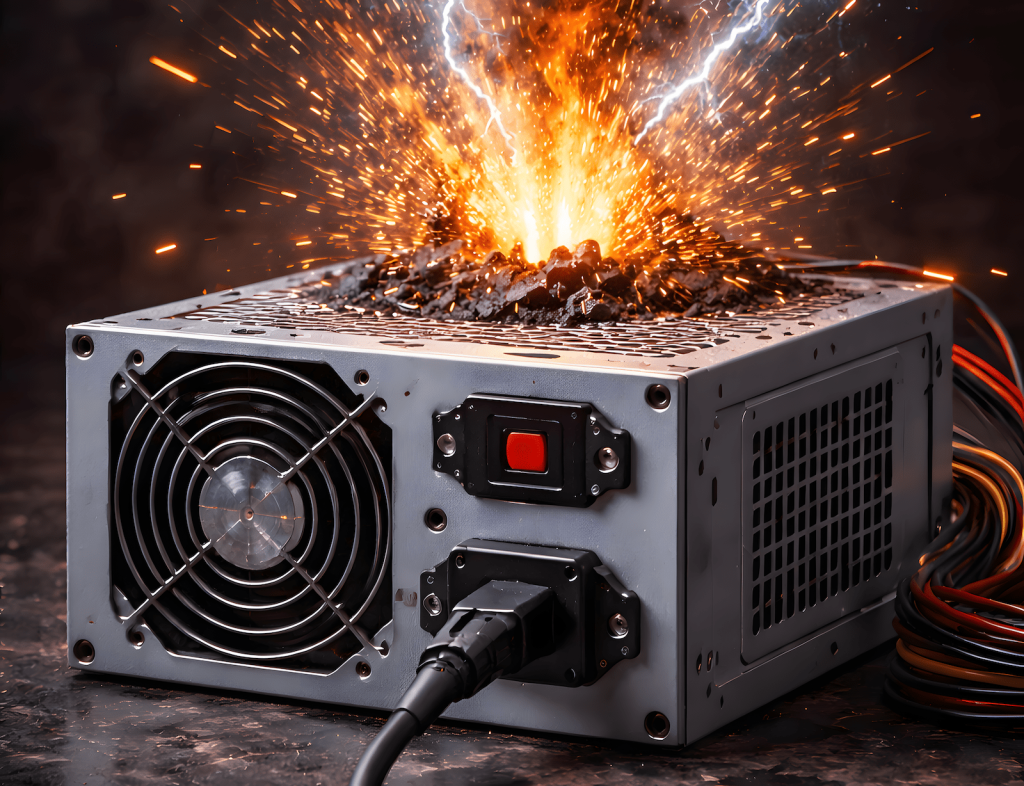
Power supplies rarely announce their limits politely.
When a PSU can’t keep up, the symptoms aren’t obvious: random shutdowns under load, black screens without error logs, system resets that look like driver crashes, storage corruption that shows up months later, and components aging faster than expected.
I’ve been upgrading and fixing computers since my teens. One thing I’ve learned: electronics don’t fail gradually, they fail at spikes and surges. A PSU that can’t handle transient loads doesn’t just underperform, it creates the exact conditions that kill components. In my experience, there’s always a 10-20% chance something will break during any major change, but that risk multiplies when the power delivery foundation can’t absorb the stress.
By the time the PSU is suspected, damage may already be done.
That’s why PSU-related failures are often misdiagnosed, and why they’re dismissed as “rare” until they happen.
The moment you replace the PSU, the upgrade math changes
Here’s where upgrade logic usually breaks.
Once you accept that the PSU may need replacement, you’re no longer doing a “simple upgrade.” You’re touching the foundation of the system.
At that point, the question shifts from “What’s the cheapest part I can swap?” to “Does this upgrade still make sense in context?”
This is where smart upgrades diverge from stupid ones.
Replacing a PSU often exposes uncomfortable truths. The budget upgrade only worked because risk was ignored. Money is being spent to protect a compromise. The system deserves a more balanced decision.
That’s why PSU discussions derail plans. They force honesty.
Wattage labels are not the same as capability
Marketing loves big numbers. Power delivery doesn’t care.
What actually matters in a PSU: stable +12V rail delivery, headroom for transient spikes, sustained operation under real load, and protection circuitry that behaves correctly.
A higher wattage rating doesn’t guarantee any of that. Neither does brand recognition or price alone.
A good power supply is boring under stress. It doesn’t draw attention to itself. It doesn’t become a variable you think about.
Why PSU decisions separate preparation from reaction
A reactive upgrade assumes yesterday’s stability applies forever, stacks new stress on old infrastructure, and treats power delivery as a footnote.
A prepared upgrade evaluates whether the foundation can support change, builds margin instead of riding limits, and reduces failure points instead of adding them.
The difference isn’t how much money is spent. It’s when the hard questions are asked.
The real role of the PSU in modern systems
The power supply isn’t about enabling performance. It’s about preventing failure.
It exists to absorb spikes without flinching, deliver clean power consistently, protect other components from cascading damage, and let upgrades happen without turning stability into a gamble.
If a PSU can’t do that, every upgrade built on top of it is conditional.
The pressure of hardware evolution
Most electronics now feel ancient after 2-3 years. Hardware has evolved to yearly new models and generations, creating constant pressure to upgrade.
But longevity and relevance are different things.
A component can work perfectly and still be three generations behind. The temptation is to extend its life with a single strategic upgrade, to squeeze one more useful year out of the platform. That’s not unreasonable, but it only works if the foundation can support it.
This is why the PSU question matters more now than it did a decade ago. The pace of hardware evolution means the gaps between components in the same system keep widening. What starts as a simple GPU upgrade becomes a decision about whether the entire platform is worth preserving.
The takeaway
If you want to know whether an upgrade is smart or stupid, don’t start with the GPU.
Start with the power supply.
If the PSU can’t support the change cleanly, the upgrade isn’t “good value.” It’s borrowed stability.
And borrowed stability always comes due.

Has been building, breaking, and fixing PCs since the 286 era—back when power supplies were measured in “please don’t catch fire” units and bottlenecks were called “waiting for the hard drive.” Still approaching upgrades the same way he approaches systems: assume nothing works until proven otherwise, especially the parts everyone ignores.
Runs HobbyEngineered, where the advice is “buy once, cry once” and shortcuts are treated with the respect they deserve (none).
Also writes about QA systems at QA Journey and cuts through AI hype at Engineered AI.
Same engineer paranoia, different domains.