The first time I played Prince of Persia, it was on a DOS PC and the Prince was wearing white. Not the cel-shaded version, not the sand-powered reboot, not the guy with the dreadlocks from the 2008 disaster. The original. Broderbund. Jordan Mechner. Jaffar. Sixty minutes on the clock and a spike trap in every corridor. That was where this franchise and I started, sometime in the 90s in the Philippines, on hardware that most people under 35 have never touched. By the time the Sands of Time trilogy arrived on PS2, I had already earned my history with this series. This prince of persia sands of time trilogy retrospective is written from that position: someone who started on PC and finished on console, across more than a decade of this franchise doing its best and worst work.
Where It All Started: The 1989 Original on DOS
Video: Prince of Persia 1 (1989) MS-DOS Gameplay via YouTube
Channel: AlphaYellow
The 1989 original is a brutal, elegant game with no patience for mistakes. You are an unnamed prince thrown into a dungeon while the evil vizier Jaffar seizes the kingdom and gives the princess one hour to agree to marry him or die. Everything about that setup is stripped down and functional. No cutscene padding, no tutorial, no checkpoints in the modern sense. Just twelve levels, a sword, and a clock that does not stop for anything.
What made the original remarkable for its time was the animation. Jordan Mechner spent years rotoscoping footage of his younger brother running and jumping in white clothes in a parking lot, tracing those movements frame by frame into the game’s sprites. The result was movement that felt genuinely human in an era when most game characters moved like they were made of cardboard. When the prince grabbed a ledge, stumbled on a landing, or got impaled on a spike trap, it looked like it actually hurt. That wasn’t common in 1989. That commitment to physicality is why the original still has weight when you play it today, even knowing everything that came after.
The spike traps are worth their own paragraph. The game did not telegraph them clearly. You could sprint down what looked like an empty hallway and end up watching the prince fold onto a bed of spikes that appeared from nowhere. There was no dramatic music cue, no slow-motion warning. You just died, immediately and with full animation. The game was teaching you to slow down, to look before committing, to treat every empty space with suspicion. That design philosophy was more sophisticated than most games of that era gave players credit for.
The Gap Years and What Happened to the Franchise
After the original and its 1993 sequel, Prince of Persia essentially disappeared from relevance for a decade. The 1999 Prince of Persia 3D existed and was largely forgettable, a clumsy attempt to push the franchise into three dimensions before the technology or design language was ready for it. Ubisoft acquired the rights in 2001 and spent two years building what became the Sands of Time. That wait was worth it. The franchise that came back in 2003 was unrecognizable in the best possible way and completely faithful to the original’s DNA at the same time.
Sands of Time: The PS2 Entry Point That Earned Its Place
Sands of Time was where the franchise moved from PC to PS2 for me, and it was the right game to make that transition with. The time manipulation mechanic was the kind of idea that seems obvious in retrospect but was genuinely fresh in 2003. Rewinding time to undo a missed jump or a botched combat sequence turned what could have been a frustrating game into one that felt generous without being easy. The game still demanded precision. It just gave you a tool to recover from your own mistakes, which changed the entire emotional register of playing it.
The Prince in Sands of Time had personality. He was witty, self-aware, occasionally sarcastic, and narrated the game from a future vantage point in a way that made the whole experience feel like a story being told rather than a series of challenges being completed. The relationship with Farah was genuinely well-written for a game of that era. The platforming sections had a flow and rhythm that felt musical when you got them right, wall-running and vaulting through corridors of traps in sequences that rewarded memorization and muscle memory in equal measure. Sands of Time isn’t my favorite in the trilogy, but it’s the most purely enjoyable game in it, and that’s a legitimate distinction.
Warrior Within: Why This Is the Best Game in the Trilogy
Prince of Persia Warrior Within is a different kind of game than Sands of Time, and that difference is exactly why it sits at the top of the trilogy ranking. Where Sands of Time was bright and adventurous, Warrior Within was dark, brutal, and willing to make you uncomfortable. Seven years after the events of the first game, the Prince is being hunted by the Dahaka, an unkillable guardian of the timeline sent to erase him for his interference with the Sands. The premise immediately raised the stakes in a way the series had never attempted before. This wasn’t a rescue mission. This was a prince running for his life, desperate enough to travel to the Island of Time and try to prevent the Sands from ever being created.
The combat overhaul alone would have made this worth playing. The Prince could now wield two weapons simultaneously, and the system for managing off-hand weapons, each with their own durability, damage output, and combat bonuses, gave fights a texture that Sands of Time’s more straightforward combat never had. The level design was nonlinear in a way that rewarded exploration and punished inattention. Time portals allowed you to move between the present and past versions of the same spaces, which created puzzles that were genuinely clever rather than just spatially complex. The game asked more of you than its predecessor, and it delivered more in return.
The tone shift polarized people at the time and still does. The Godsmack soundtrack, the darker art direction, the Prince’s characterization as a brooding antihero rather than a charming rogue, all of it was deliberate and all of it worked for what the game was trying to be. Warrior Within wasn’t trying to be Sands of Time again. It was trying to push the series into territory it had never occupied, and it succeeded on its own terms completely.
The Dahaka: The Enemy That Made You Scream
Video: Prince of Persia Warrior Within All Dahaka Chases + Final Battle via YouTube
Channel: Global Gaming
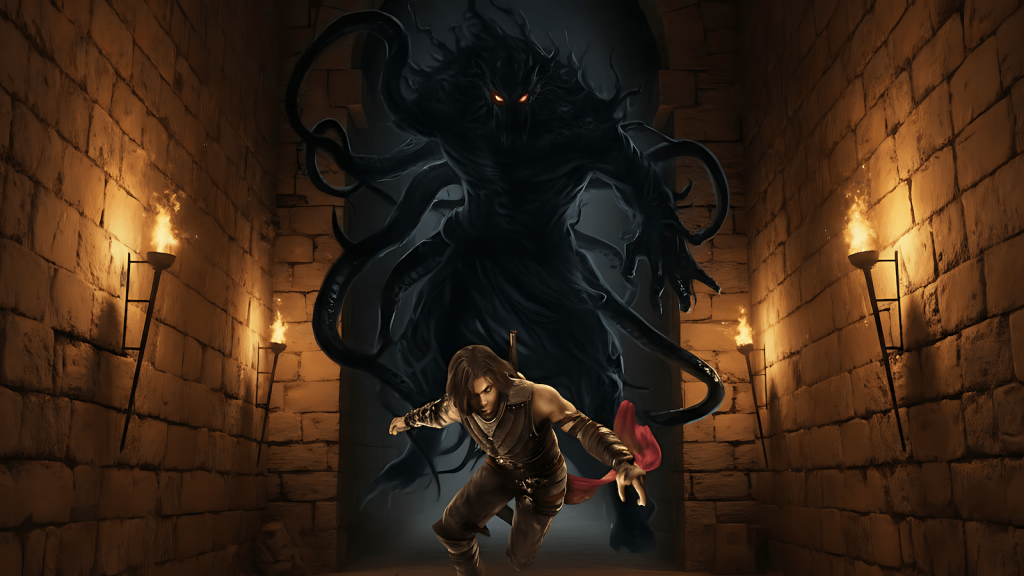
No retrospective of Warrior Within can exist without addressing the Dahaka directly. This is the enemy that made me scream like a kid and kept doing it every single time it appeared. Not once. Every time. The Dahaka isn’t a boss you fight at the end of an area. It’s a relentless pursuer that cannot be harmed by any weapon in your possession, exists for the sole purpose of ending your run, and appears without warning at any point in the game. Every encounter is a chase sequence, and chase sequences live or die on their design.
What made the Dahaka work for me was the disempowerment. By the time it first appeared, I had already spent hours cutting through sand creatures, learning the dual-weapon system, and starting to feel genuinely dangerous. The Dahaka erased all of that in one roar. Warrior to prey in under a second, and every skill built over those hours became completely useless. That whiplash is the core of why it hit so hard. The game spent considerable time making you feel like the most dangerous thing on the Island of Time, and then it sent something to remind you that you were a man who was supposed to be dead.
The sound design made it worse in the best possible way. The deep distorted roar that preceded its arrival triggered something physical before my brain had time to process what was happening. Then the boss music kicked in and that was it, it subconsciously did something like hands tightening on the controller, breathing changed, everything narrowed to the next ledge and the next door. That track isn’t background music. It’s a cue hardwired to panic, and no matter how many times I had survived a Dahaka sequence, the music reset the fear response every single time. It told my body that survival was not guaranteed, and my body believed it without asking questions. There’s a detail about the Dahaka’s audio that I only discovered later. According to the Prince of Persia Wiki and documented on eeggs.com, the Dahaka speaks in reverse but you could actually decode it yourself in-game by using the Recall ability to rewind time right after it finished speaking. What it was saying the whole time: You will be removed. Disrupt the Timeline no further. Come to me… come to your death. The game gave you the tool to understand your pursuer, and most players never knew it. That’s either brilliant design or the cruelest Easter egg ever put in a PS2 game.
The water weakness is not explained. There was no tutorial, no NPC flagging the mechanic, no prompt telling me what I had just witnessed. I crossed a water barrier during a chase and the Dahaka stopped at the edge. That was the entire lesson. The game showed me something and left me to figure out what it meant, the same design logic that runs through old Sierra games like Conquest of Camelot, where nothing in the world becomes real until you actively demonstrate awareness of it. Both games refuse to bridge the gap between visible and understood. You see the Dahaka halt. You stand there. You work it out yourself. And because you worked it out yourself, it actually means something when you use it.
Water barriers become your lifeline throughout the entire game from that point forward. They don’t defeat the Dahaka, they buy you time, break the chase, give you room to breathe. The Dahaka is still out there. It’s still coming. Water just means it can’t follow you through that particular door. The actual weapon against it is something else entirely, and it’s locked behind the game’s most demanding requirement: all nine life upgrades. Collect them all and the Water Sword appears in the Hourglass Chamber. That’s the only thing in the game that can actually damage the Dahaka and the only path to the true ending is Kaileena alive, the timeline broken in your favor. Miss even one upgrade and you get the non-canon ending: Kaileena absorbed, the Prince sailing home alone into a city already burning. Most players finished Warrior Within without knowing a second ending existed. They escaped the Dahaka with water for twenty hours and never got to turn around and fight it. The Water Sword is what finishing the game actually looks like.
Two Thrones: A Worthy Finish With One Major Flaw
Two Thrones arrived in 2005 to close out the trilogy and largely succeeded at that task. The game brought back the witty, more likable Prince from Sands of Time while keeping the combat depth of Warrior Within, and it used the Dark Prince as a narrative device to explore the tension between those two versions of the character. The speed kills system was a genuine addition, rewarding fast and aggressive play with brutal, stylish takedowns that felt satisfying in a way that neither previous game had quite achieved. The story wrapped the trilogy’s arc in a way that felt earned rather than convenient, which is harder to do than it sounds.
The fundamental problem with Two Thrones is the forced switching between the Prince and the Dark Prince. The design intent is clear: the player is meant to experience the internal conflict of the character through gameplay, alternating between two modes that represent different aspects of his personality. In practice, being pulled out of the Prince’s more capable combat system and into the Dark Prince’s drain mechanic broke the momentum every single time. You built rhythm, you got comfortable, and then the game forced the switch. It’s the one design decision in the trilogy that prioritizes concept over execution, and it costs the game its shot at the top ranking.
Two Thrones is a good game and a fitting conclusion. It’s not the best game in the trilogy. It earns its place at the bottom of a strong three-game run, which isn’t an insult so much as an honest accounting.
Everything After Two Thrones
The 2008 Prince of Persia reboot deserves to be mentioned only to be dismissed. A cel-shaded art style that looked borrowed from a different franchise entirely, a companion character who caught you every time you fell and removed the consequence that the series had been built on since 1989, and a protagonist who bore no meaningful resemblance to any version of the Prince that had come before. The game wasn’t bad at what it was trying to be. It just wasn’t Prince of Persia in any way that mattered to anyone who had started with Jaffar and a sixty-minute clock.
The subsequent entries did not improve the situation. The franchise lost its identity when it stopped understanding what had made it work in the first place: physical consequence, a specific kind of controlled danger, and a protagonist whose competence was earned through the player’s own skill and repetition. The original DOS game had that. The Sands of Time trilogy had it in three different flavors. Nothing after Two Thrones came close to recovering it.
The Final Ranking
For anyone who wants the honest order without qualification:
Warrior Within sits at the top. It’s the most complete realization of what Prince of Persia could be when it pushed past the formula and committed to something genuinely difficult and dark. The original 1989 DOS game sits second, not out of nostalgia but because its design discipline is unmatched in the series. Sands of Time is third, the most enjoyable game in the trilogy and the best entry point for anyone coming to the franchise for the first time. Two Thrones closes the ranking, a good game that finished what it needed to finish without quite becoming the game its predecessors were.
The franchise started in a dungeon with spike traps and a countdown clock. It found its peak in a dark castle with an unkillable monster and a Godsmack track on the soundtrack. Everything it needed to be, it already was by 2005. The games that came after were someone else’s franchise wearing a familiar name.