
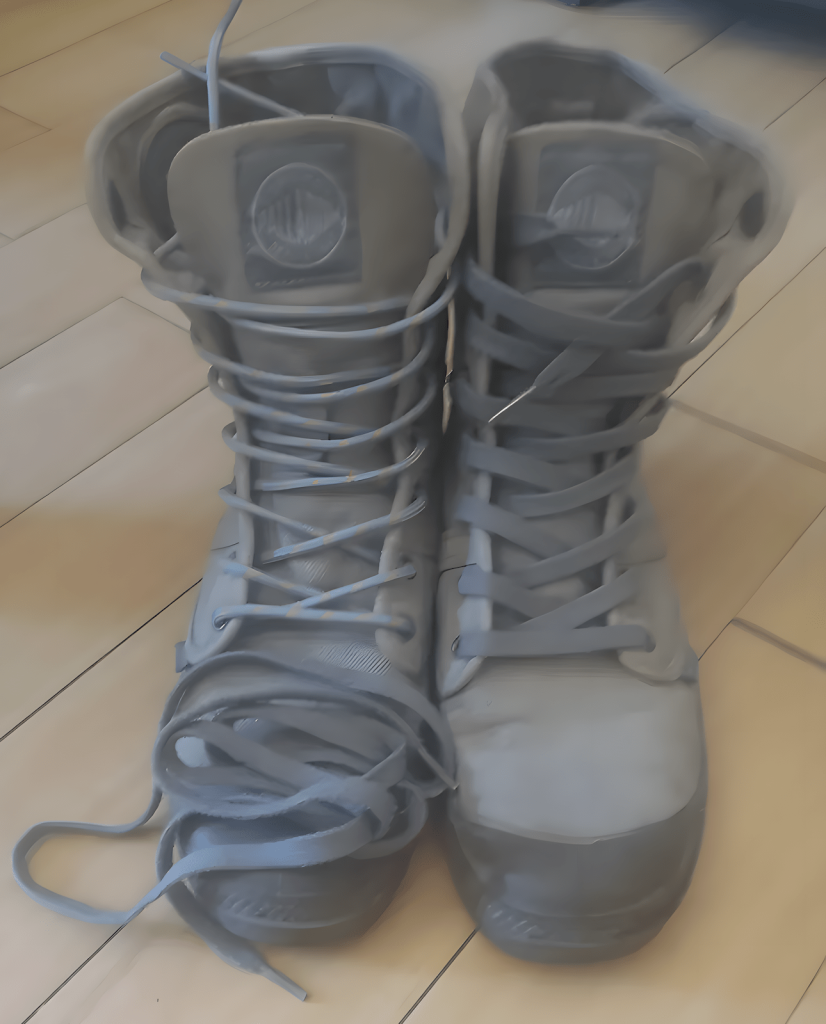
There is a particular kind of confidence that comes from owning a piece of gear that simply refuses to quit. My Palladium Baggy Hi boots have been on my feet through more than two decades of daily use, city streets, outdoor walks, and yes, even formal occasions with a suit and tie. The canvas is faded, the gray sole has developed a green patina from years of exposure to rain, grass, and time, and I have since swapped the original laces for round paracord ones with a blue and orange fleck pattern. They are, without question, the most cost-effective piece of gear I have ever owned. And right now, a whole new generation is discovering what a quiet group of us never forgot.
Where Palladium Actually Comes From
Most people who pick up a pair of Palladiums today know them as that chunky canvas boot with the thick rubber sole, the kind of shoe that looks equally at home on a city block or a trail. What most people do not know is that Palladium started out making aircraft tires. The company was founded in Lyon, France in 1920, and for nearly three decades they supplied the aviation industry with high-performance rubber products. After World War II, the demand for aircraft tires collapsed almost overnight, and the company faced a serious pivot-or-die moment. In 1947, they made a decision that seems obvious in hindsight: take everything they knew about vulcanized rubber and durable construction, and apply it to footwear. The first boots they produced went to the French Foreign Legion for use in desert and harsh-terrain operations. That is not a marketing story. That is an actual engineering lineage, the kind of origin that explains why a canvas boot bought in the early 2000s is still structurally sound today.
Understanding that history reframes how you look at the boot itself. The thick rubber sole is not a stylistic choice lifted from some trend board. It is the direct descendant of materials science developed for aircraft applications, where failure is simply not an option. Vulcanized rubber is cross-linked at a molecular level through heat and sulfur, which gives it resistance to cracking, deformation, and degradation over time in a way that regular rubber cannot match. When you pick up an old pair of Palladiums and press on the sole, you are feeling the practical benefit of an industrial process developed for one of the most demanding engineering contexts humans have ever created. That is a pretty remarkable thing to have on your feet.
What Two Decades of Daily Use Actually Looks Like
My pair is a gray canvas Baggy Hi from the early 2000s. The canvas upper has faded from its original gray to a softer, more weathered tone that honestly looks better now than it did when new. The gray rubber sole has developed a green patina in the deeper tread grooves, the kind of discoloration that comes from years of contact with moisture, organic matter, and the general accumulation of everywhere a shoe has ever been. The eyelets are still solid, the stitching along the toe cap has not separated, and the bond between the upper and the sole has held up far better than most footwear of similar age. I am planning to clean the sole rather than paint it, and for the canvas I am considering a gunmetal gray acrylic paint mixed with fabric medium to restore the color while keeping flexibility in the material so it does not crack at the flex points.
The one modification I have made over the years is replacing the original flat laces with round paracord shoelaces, the kind with a blue and teal braid and orange fleck running through it. Paracord is rated for several hundred pounds of tensile strength and resists fraying in a way that standard cotton or synthetic laces simply do not. I use the same paracord laces across my other shoes, a pair of Merrell trail shoes and my Nike Cuts, which creates an unintentional but coherent visual signature across the whole rotation. The Palladiums are still the daily driver though. The Merrells handle serious trail work, the Nikes cover casual athletic days, but the Palladiums go on for everything else, including dressed-up occasions where the contrast between a fitted suit and a chunky utilitarian boot creates exactly the kind of high-low tension that makes an outfit interesting rather than predictable.
The Engineering Case for Longevity
Most modern footwear is designed around a two to three year replacement cycle, with materials engineered to perform well initially and then degrade at a rate that encourages repurchase. Palladiums from the early production era were not designed with that philosophy in mind, partly because the brand was still operating with an industrial rather than a fashion mindset. The canvas used in the Baggy Hi is a heavy plain weave cotton, tight enough to resist abrasion but breathable enough for all-day wear. The rubber compound in the sole is formulated for flexibility across a wide temperature range, which is why these boots do not become brittle or delaminate the way cheaper footwear does over time. Good materials, sound process, no shortcuts. That philosophy is rarer than it should be in modern consumer goods, and it is the core reason a boot from the early 2000s is still worth wearing in 2026.
When the Boot Needed Help, a Cobbler Made It Stronger
Years into daily use, the adhesive bond between the canvas upper and the rubber sole started to give way. This is the most common failure point in vulcanized footwear, and it is not a sign that the boot is finished. It is just chemistry losing a long argument against time and repeated flexing. I brought the pair to a shoe repair shop, and the cobbler’s solution was not to re-glue the bond but to stitch it. He ran a careful line of stitching along the seam where the upper meets the sole, reinforcing the entire junction mechanically rather than just chemically. The result was a repair so clean and precise that you cannot see it unless you are specifically looking for it.
The cobbler was right, and the engineering backs him up. Stitching is mechanically superior to adhesive for this kind of joint because it creates a physical interlocking connection distributed along the entire seam. Adhesive relies on surface chemistry that degrades with heat, moisture, and repeated stress cycles. A stitch does not dry out or delaminate. It holds as long as the thread holds, and a good waxed thread in a protected seam can last decades. The repair did not devalue the boots. It upgraded them. That is the right way to think about it, not as a patch on something failing, but as an intervention that made a good thing better than it was originally built to be. If you own an older pair with a lifting sole, find a cobbler who stitches rather than re-glues. It is worth every peso.
Styling Palladiums Beyond the Obvious
The internet is currently rediscovering Palladiums through the gorpcore and utilitarian fashion lens, which is fine, but it undersells the boot’s actual range. The chunky sole and high ankle silhouette read as military surplus adjacent, which pairs naturally with cargo trousers, technical outerwear, and layered casual fits. What is less discussed is how well they work with tailored clothing. A gray canvas Palladium Baggy Hi under a charcoal or navy suit creates a deliberate contrast that signals confidence rather than carelessness. The key is keeping everything above the boot sharp and well fitted so the boot reads as a choice rather than an oversight. For those building a minimal, functional wardrobe around gear that actually performs, Palladiums belong in the same conversation as a well-specced go bag or a reliable multitool. They are functional objects that happen to look good, which is a much more interesting and durable proposition than the other way around.
Maintenance for the Long Haul
For the canvas upper, acrylic paint mixed with fabric medium is the most flexible and durable option for color restoration. Apply it in thin coats with a flat brush, letting each coat dry fully before adding the next, and you will end up with a finish that moves with the canvas rather than cracking at the flex points. Gunmetal gray works particularly well for the original gray colorway because it restores depth without looking freshly painted. For the rubber sole, cleaning is almost always better than painting. A stiff toothbrush with a baking soda and water paste handles most surface grime, and a small amount of acetone on a cotton pad applied only to the rubber cuts through deeper oxidation effectively. The green patina in the tread grooves is partly organic and partly structural, some of it will clean off, some will stay, and both outcomes are fine. Lace replacement is the highest impact, lowest cost modification you can make. Round 550 paracord cut to length with the ends melted and sealed makes an essentially permanent lace that will outlast the boot itself.
Why This Boot Deserves More Than a Trend Moment
Palladiums are having a social media moment right now, and that is genuinely good for the brand and for anyone who has been quietly loyal to them for years. The Palladium Baggy Hi is not interesting because it is back in style. It is interesting because a company that made aircraft tires pivoted to footwear after a world war and created one of the most durable canvas boots ever put into production. It is interesting because a pair bought in the early 2000s can still be a daily driver in 2026 with basic maintenance, a lace swap, and one good cobbler visit. The people who never stopped wearing them were not ahead of any trend. They just found something that worked and saw no reason to stop.
My gray Baggy Hi has faded canvas, a patinated sole, stitched seams, and paracord laces. It has been on my feet longer than most of the technology I own has existed. It will probably outlast whatever shoes I buy next. That is not a trend. That is just good engineering.