
Some links on this page are Amazon affiliate links. If you choose to buy through them, HobbyEngineered may earn a small commission at no extra cost to you.
These links only appear where tools or everyday support items naturally fit the topic. No sponsored placements. No hype.
Most modern hobbies are being engineered out of existence.
Not because people don’t enjoy them, but because everything around them is optimized for speed, convenience, and automation. Press a button. Skip the process. Get the result. Move on.
Coffee followed that path.
Pods, drip machines, timed brewers. They all work. They’re efficient. They remove friction. And in doing so, they remove the reason a hobby exists in the first place.
The French press never joined that race. That’s why it still wins.
Convenience Works. That’s the Problem.
I own simpler coffee makers. I’ve used drip systems. They do exactly what they promise.
But they ask nothing from you.
There’s no pacing. No feedback. No consequence for rushing or inattention. You can walk away, check your phone, come back, and coffee is just there.
That’s fine for fuel. It’s terrible for a hobby.
A hobby survives on interaction, not output. Once the process disappears, so does the skill.
The French Press Refuses to Be Rushed
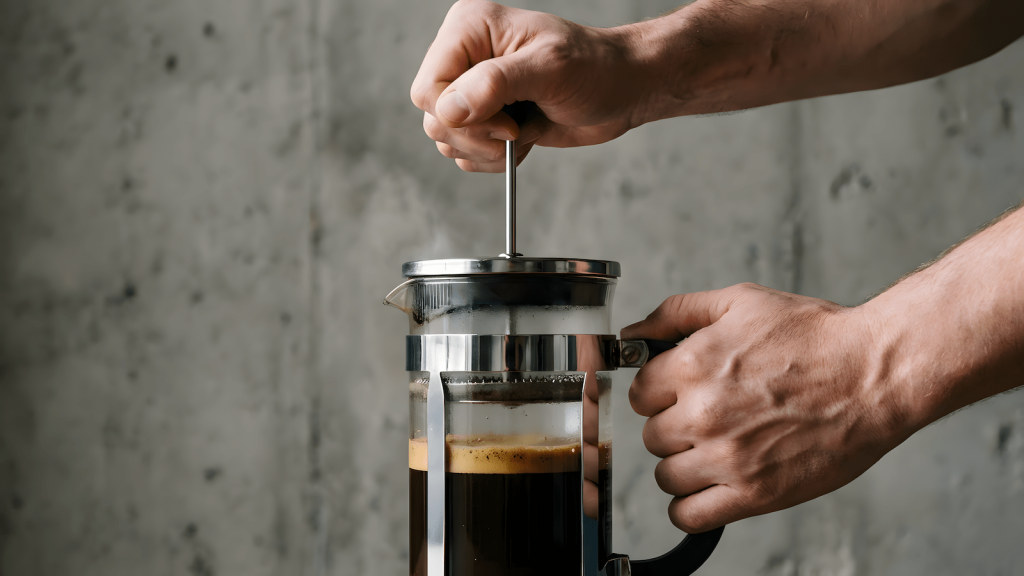
The defining feature of the French press is resistance.
You can’t force it. Press too fast and you ruin the extraction. Rush the timing and the flavor collapses. The plunger pushes back. The cup tells on you immediately.
When you press slowly, everything changes. You smell the extraction as it happens. Heat, bloom, bitterness pulling back, body settling in. You stay with it because you have to.
This is why it feels closer to old crafting systems than modern appliances. Not because it’s romantic, but because sequence and timing matter.
Games like The Elder Scrolls V: Skyrim or The Witcher 3: Wild Hunt understood this instinctively. Combine ingredients in the wrong order or rush a step and the outcome changes. The logic is simple and deeply human.
The French press works the same way.
The Process Does the Work
The French press doesn’t demand perfect beans.
I’ve brewed premium coffee. I’ve also brewed commercial beans. Cheap beans. Old beans. Mixed beans. The kind you buy because they’re available, not because they’re special.
And I still enjoy the cup.
The process does a lot of the work. Slow extraction. Controlled press. Time instead of force. Even when the ingredient quality isn’t ideal, the method pulls out more than convenience brewing ever will.
This is where the alchemy comparison actually makes sense.
In potion-style crafting systems, ingredient quality sets the ceiling, but execution determines how close you get to it. Use common ingredients and you won’t get a legendary result. Rush the process and you waste potential entirely.
The French press operates on that same logic.
The quality of the coffee improves, yes. But that’s secondary.
What actually changes is your engagement.
Manual brewing forces single-tasking, physical feedback, attention to timing, and acceptance of variation.
Every cup is slightly different. Not because you failed, but because the system allows nuance.
When a process can’t be perfected, it stays interesting.
Coffee That Doesn’t Need to Perform
I’ve been drinking coffee for a long time. How long? I don’t know. Long enough that caffeine doesn’t really do what it’s supposed to anymore. Coffee can make me sleepy. And that’s fine.
I don’t drink coffee for stimulation. I drink it because it’s familiar. Relaxing. Something I reach for regardless of the time of day or the weather. Even in summer, I’ll still make coffee.
I just don’t drink it scalding hot.
I like it warm. Hot enough that you feel it in your mouth and throat. Warm enough that the heat is part of the experience. Not hot enough to burn your tongue or rush the drink.
That temperature matters. It forces patience without turning it into a test of endurance. The French press makes that kind of control natural.
Controlled Chaos, Not Optimization
I don’t pretend my setup is optimized.
I usually go Arabica. Dark roast. That’s common here in the Philippines, along with blended beans. I avoid flavored coffee. Hazelnut, French vanilla those are mostly aroma, not taste. Once you stop masking the beans, that becomes obvious.
I don’t grind my own coffee. I don’t own a grinder. I buy pre-ground. Usually coarse, sometimes rougher than ideal. For a French press, finer would be better.
And it still works.
Because the press, the timing, and the repetition compensate. Not perfectly. Not consistently. But enough to keep the process engaging.
Some days the cup is better. Some days it’s not. That variability is part of the craft.
Frothing: Where the Alchemy Actually Lives
Manual milk frothing looks optional until you do it enough times to fail.
Some days the foam is thick. Some days it collapses. Sometimes the temperature is right, sometimes it isn’t. You can cheat with whipped cream, but the difference is obvious the moment you taste it.
There is no preset.
You learn through repetition: how fast is too fast, when heat ruins structure, when air stops helping.
It becomes muscle memory over time, but muscle memory lies if you get complacent. Precision still matters. Attention still matters.
Transformation through controlled effort.
Why Automation Fails as a Hobby
Automation isn’t the enemy. Misuse is.
Automation is perfect when the goal is output. It’s destructive when the goal is engagement.
Once everything is optimized, there’s nothing left to learn, nothing left to refine, nothing left to pay attention to.
The French press avoids that trap by staying deliberately simple and stubbornly manual.
No firmware. No presets. No updates.
Just cause and effect.
Why It Still Wins
The French press has survived because it satisfies three conditions most modern hobbies fail: it resists speed, it rewards repetition, it never fully automates skill.
You can improve without exhausting it. You can repeat it daily without burning out on it. You can step away and come back without relearning everything.
That’s rare now.
If you want the experience to work, keep it simple: Brew manually. Press slowly. Froth by hand when you feel like it. Stay with the process until it’s done.
No phone. No rushing. No shortcuts.
If you mess up, the cup tells you. If you rush, the press pushes back. If you lose focus, the result degrades.
Not because it makes coffee.
Because it preserves the hobby.

Treats hobbies the same way he treats systems: process matters more than outcomes. Enjoys tools and rituals that reward patience, feedback, and repetition—whether that’s a French press, aging hardware, or anything that refuses to be rushed.
Runs HobbyEngineered, where hobbies are judged by engagement, durability, and craft—not convenience, trends, or influencer shortcuts.
Also writes about QA systems at QA Journey and cuts through AI hype at Engineered AI.
Same engineer mindset, different tools.
Pingback: Caffeine Is a Crutch – Tactical Use Without the Crash