Sleeping Dogs is an open-world action game where you play as Wei Shen, an undercover cop infiltrating Hong Kong’s triads. Released in 2012, it’s basically what you’d get if you crossed GTA’s open-world structure with Arkham’s combat system and dropped it into a Hong Kong action movie.
I first played Sleeping Dogs on the PS3. Then I picked it up on PC, though the keyboard and mouse controls felt clunky. When I connected a controller to my PC, especially one with a proper home button, the game suddenly clicked. Now I’ve got it on my PS4, and I’m enjoying it all over again.
This is a game I keep coming back to, and here’s why it’s aged so well.
Hong Kong Feels Like Home (Or At Least Like Manila)
Every modern open-world game wants to brag about how big their map is. Hundreds of square kilometers of empty desert or copy-pasted forests. But coming from the Philippines, that’s not what makes a city feel real to me. What matters is how tight everything is packed together. How every inch of space gets used for something.
Hong Kong in Sleeping Dogs isn’t massive. It’s compact. But it feels familiar. The verticality. Shops stacked on shops. Constant hum of people. Every square inch of sidewalk being used for something. It’s like Manila in that way, and that familiarity is probably why the game works so well for me.
Most games give you a map to conquer. Sleeping Dogs gives you a neighborhood to inhabit.
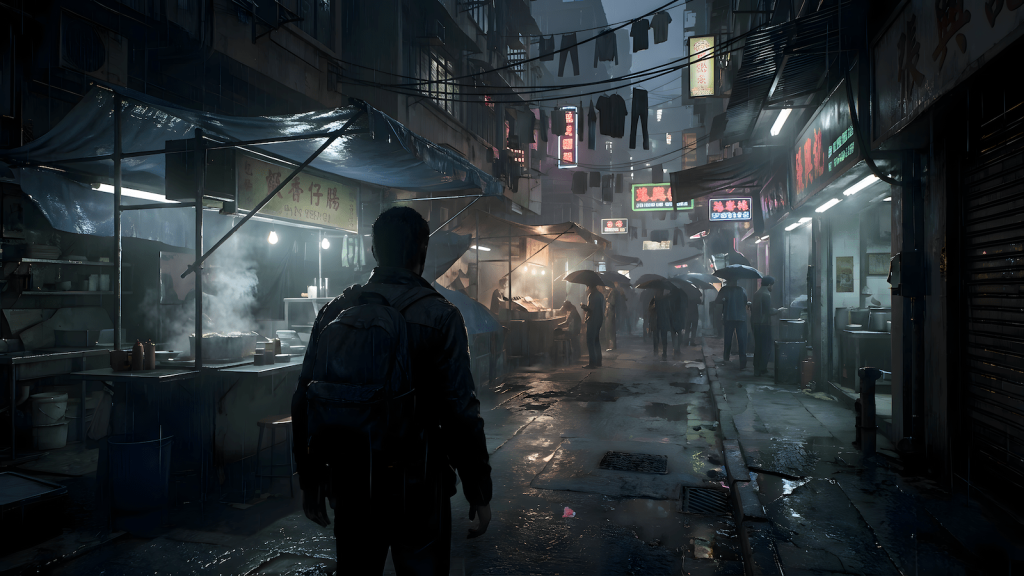
You don’t just fast travel past the world. You weave through it. I spent hours just navigating the Night Markets, not because a mission told me to, but because the ritual felt right. There’s a specific joy in hunting for the right pair of knock-off shoes or a specific jacket to boost your stats. It captures that feeling of being in a crowded Asian metropolis where stuff is everywhere, and you have to carve out your own identity through what you wear and where you eat.
Whether it’s grabbing a quick bowl of noodles from a street vendor or just standing under the glow of the signs during a rainstorm, the game captures the vibe of the city through its density rather than its distance. The claustrophobia is what makes it real.
The Story: Wei Shen’s Slow Unraveling
The story gets compared to Hong Kong action cinema a lot. Jackie Chan movies, John Woo’s heroic bloodshed films. And yeah, it’s got that melodramatic flair. But the real heart of it is watching Wei Shen get pulled apart.
He isn’t just a cop playing criminal. He’s a man being torn between two versions of himself. And the game shows this through more than just dialogue. You see it in where he lives, how he carries himself, what he’s willing to do.
At the start, Wei lives in a cramped, depressing safehouse. Concrete box. Barely furnished. As the story progresses, his apartments get nicer. He moves from the slums to a luxury penthouse. But his actions? They get uglier.
You’re watching a man lose his cop identity and lean into the sheer brutality required to survive the Sun On Yee. It’s not just plot twists. It’s watching someone’s soul get calloused over. By the final acts, Wei isn’t fighting for the law. He’s fighting for a twisted sense of brotherhood and vengeance that has nothing to do with his badge.
Wei Shen’s Physicality Tells the Story Too
What I appreciate is how Wei’s physical presence changes. Early on, he’s controlled. Professional. Restrained. But as the game goes on, you feel the shift.
The way he moves through fights becomes more aggressive. The environmental kills get more brutal. You’re not just countering attacks anymore. You’re slamming heads into phone booths, throwing people into dumpsters, using meat grinders. The violence escalates because Wei is escalating.
It’s brilliant because the gameplay mirrors the psychological breakdown. You feel Wei losing control through your own hands on the controller.
The Combat: Street Fighting at Its Best
Yeah, people compare this to the Arkham games. Counter system, rhythm-based attacks, flowing combos. But Sleeping Dogs feels different. In Arkham, you’re a superhero. Here, you’re a guy who’s often one mistake away from being overwhelmed by a mob with meat cleavers.
The combat is an extension of the environment. It’s about the frantic energy of a street fight where you have to use whatever’s nearby. The Jade Statue system is a brilliant way to handle progression. You’re reclaiming Wei’s heritage as you learn new moves from your Sifu.
But the real star is the brutality. There’s weight to every punch. A crunch to every counter. When you finally unlock the advanced moves, Wei becomes a force of nature, but it never feels clean. Whether you’re slamming someone into a shutter door or using tight alleyway corners to funnel thugs, every fight feels like a struggle for survival.
And here’s the thing. The combat depth is there:
- Light attacks flow into heavy attacks
- Grapples break enemy guards
- Counters create openings
- The Face meter lets you steamroll when it activates
- Weapons break after a few hits
- Different enemy types force you to adapt
One detail I always appreciated: when the cops show up and try to cuff you, it isn’t an instant fail state. If you’re quick, you can fight your way out of it. It doesn’t feel scripted. It feels like a street scuffle spiraling out of control, and you clawing your way back into motion.
But what I love most is making my own chaos. I’ll walk around, bump into someone. If they get mouthy, I beat them up. Others join in? Beat them up too. Cops show up? Beat them up too. Then I steal a motorcycle and see how far I can run.
That’s my side mission. That’s my gameplay loop. The game lets you create your own moments of chaos, and that’s what makes it timeless.
It Runs on Basically Anything (Well, the Original Does)
I recently revisited Sleeping Dogs years ago on an old Dell Inspiron 15R 5521 with an i7-3537U and Intel HD 4000 Graphics. That’s integrated graphics from 2012. And you know what? The original version runs beautifully at 720p.
While the Definitive Edition often chokes on older hardware due to unoptimized lighting effects, the original is a miracle of engineering. It runs on hardware that has no business playing open-world games. I even recorded gameplay on that old Dell just to prove it works.
If you’ve got an old laptop lying around and you want to experience a world that feels more real than most modern releases, grab the original version. It’s proof that good art direction beats raw polygon counts every time.
Final Thoughts
Sleeping Dogs didn’t need a massive, empty map to become a classic. It just needed a soul.
By focusing on a compact, dense version of Hong Kong that feels strikingly similar to the crowded, vibrant streets I know in the Philippines, the developers created something timeless. The best games aren’t the ones with the most space. They’re the ones with the most life packed into every corner.
More than a decade later, I still find myself going back. Walking those streets. Starting random fights. Finding the perfect outfit. Living in that friction.
That’s what makes Sleeping Dogs stand the test of time.
What games do you keep returning to years after release? Drop your thoughts in the comments.