My first RPG character was a smuggler.
I didn’t pick it because I understood balance, builds, or systems. I picked it because I saw the Millennium Falcon, and the smuggler had a blaster. That was enough logic at the time. I also added gambling as a primary skill.
I still don’t know why.
It just felt like something Han Solo would have.
That was my first RPG character, and at the time I didn’t even fully understand what an RPG was. I just knew it was Star Wars, it was on paper, and you got to exist inside the universe instead of watching it.
What an RPG Was, Before Everything Became Digital
When people hear “RPG” now, they usually think of computer games. Stats, skills, builds, DPS, progression. All of that language already existed back then.
The difference wasn’t the concepts.
The difference was where the game lived.
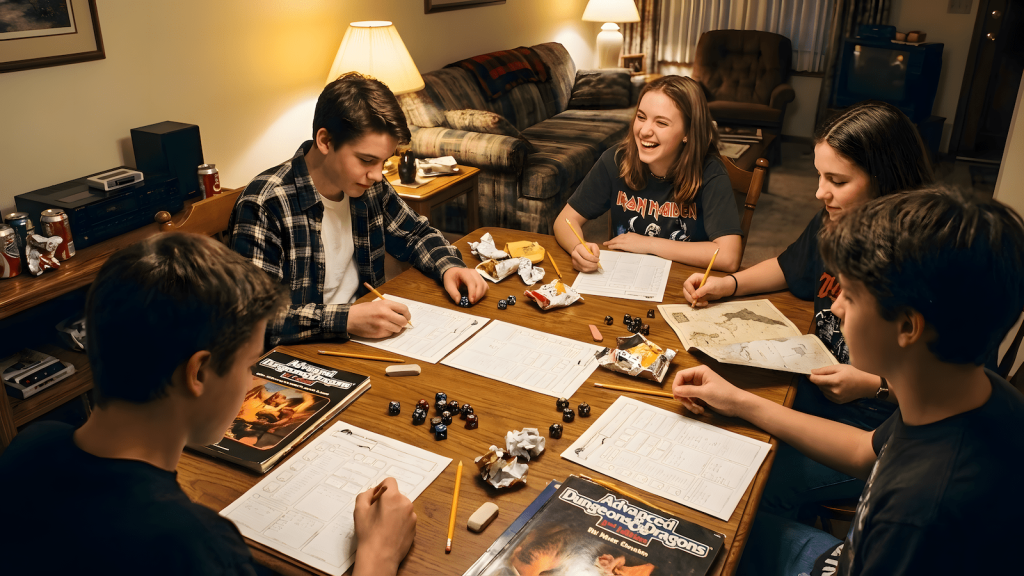
A pen-and-paper RPG lived entirely in the room.
You had a character written on paper. Stats, skills, equipment, damage. That sheet defined what you could reasonably do and how likely you were to succeed. It was your interface. There were no menus, no tooltips, no prompts telling you what was possible.
If you wanted to do something, you said it out loud.
“I shoot.”
“I bluff.”
“I gamble.”
“I go right.”
Then dice were rolled, not for spectacle, but to introduce uncertainty. Dice were the random number generator. Everything else was judgment, memory, and agreement.
That was the loop: decision, roll, consequence.
Why Star Wars Worked Immediately
Star Wars worked perfectly for this kind of game because nobody needed it explained.
Everyone already knew the universe. The Empire. Rebels. Blasters. Smugglers. Ships. Jedi existed, but they weren’t everywhere. They felt special, risky, rare.
So when we sat down to play, there was no onboarding. No exposition dump. You already understood the stakes.
That’s why my first character wasn’t creative. It was mimicry. I didn’t yet realize you could be anyone in the Star Wars universe. I thought you picked a role and stayed inside it.
Smuggler meant blaster, ship, and questionable decisions.
The imagination part came later.
The Rulebook Existed, but It Wasn’t the Game
There was a rulebook. I’m sure of that.
I don’t remember owning it. I don’t remember reading it cover to cover. Someone borrowed it from a friend or a classmate, and we referenced it when arguments came up.
That was normal.
The rulebook wasn’t the experience. It was the structure. It explained what skills meant, how dice rolls worked, and what counted as success or failure. You used it to resolve disputes, not to dictate play.
Looking back, it was almost certainly Star Wars: The Roleplaying Game, but at the time that distinction didn’t matter. It was just the Star Wars RPG.
The game didn’t fall apart because we didn’t fully understand the rules. It adapted.
The Game Master Built the World as You Moved Through It
One person ran the game. That was the Game Master.
They weren’t just enforcing rules. They were building the world in real time.
You’d reach a junction.
Left or right.
You choose right.
The Game Master describes a long hallway. At the end, a locked door. Maybe guards. Maybe a choke point. Suddenly a simple decision has shape, risk, and consequences.
Nothing was pre-rendered. The environment only existed because it was described and remembered. The world reacted to what you did, not because it was scripted, but because someone was actively responding to your choices.
In our group, the Game Master was my brother.
By the third round, we were all dead.
Paper Was the Interface, and Time Was Flexible
Your character lived on paper.
Stats were written in pencil. Damage got erased and rewritten. Gear changed hands. Skills evolved. Lose the paper, and the character was gone. No saves. No backups.
What’s important to understand is how time actually worked.
Campaigns didn’t happen in one sitting. Some of them took months to finish, even when they were short stories. Not because the plot was huge, but because we were kids.
Sometimes we were only allowed to play for thirty minutes. Then it was homework. Then dinner. Then bedtime. The game stopped and waited. We picked it up later. Sometimes the next day. Sometimes the next week.
That waiting wasn’t a flaw. It was normal.
Characters stayed alive longer because of that. If your character survived, you reused them. You didn’t always roll a new one just to experiment. Survival mattered because continuity mattered.
Setup and Worldbuilding Were Half the Experience
A lot of the excitement wasn’t even the action.
Setting up the game took time. The Game Master describing the world took time. Cities, corridors, factions, situations. That could take hours, stretched across sessions.
That wasn’t filler. That was the game.
You weren’t rushing toward a boss fight. You were inhabiting a place that only existed because everyone at the table remembered it the same way.
When Time Suddenly Mattered
Most of the time, in-game time moved loosely.
But sometimes the Game Master would set constraints.
“This session is short.”
“This one is fast.”
“This scenario has a time limit.”
Then the pacing changed.
One minute of real time might equal a day in the game. Decisions carried more weight. You couldn’t stall forever. The tension increased because it was designed to.
That wasn’t automatic. It was intentional.
What Reacted Immediately
The game waited for you.
What didn’t wait were the consequences.
Once you made a move, the world responded immediately. The door stayed locked. The guards noticed you. The dice decided whether it worked.
The waiting was human.
The reaction was instant.
That balance is what made those games feel alive.
From Copying to Creating
My first playthrough wasn’t creative. It was imitation.
I copied Han Solo because that’s what I knew. Smuggler. Blaster. Gambling. Those were my training wheels.
On later playthroughs, something shifted.
I realized you weren’t supposed to recreate characters. You were supposed to invent them. Let them grow. Let them fail. Let them survive or die in ways that weren’t scripted.
Sometimes the stupidest choices became the most memorable moments, especially when the Game Master had no mercy.
Why That First RPG Still Matters
That Star Wars RPG was my first real RPG experience.
Not because we played it perfectly.
Not because we mastered the rules.
Not because we lasted very long.
But because it showed me a different way games could work.
You weren’t consuming content.
You were participating in it.
You weren’t following markers.
You were making decisions.
The first time, I copied Han Solo.
The next time, I used my imagination.
That’s the part that stuck.

Grew up in the era where games required imagination, memory, and patience. Treats hobbies as lived systems—things you sit with, return to, and slowly understand over time, not consume and discard.
Runs HobbyEngineered, where hobbies are examined the same way old games were played: deliberately, imperfectly, and without shortcuts. Also writes about QA systems at QA Journey and cuts through AI hype at Engineered AI.
Same engineer mindset, different playgrounds.