High refresh rates are everywhere. 144 Hz, 240 Hz, 360 Hz: numbers screamed across every gaming monitor review, every spec sheet, every marketing campaign. The pitch is simple: higher Hz equals smoother gameplay, better visuals, competitive advantage.
Reality? Most of it is compensation for a problem that didn’t exist before LCDs.
This isn’t about nostalgia. It’s about physics.
What Actually Happened to Display Motion
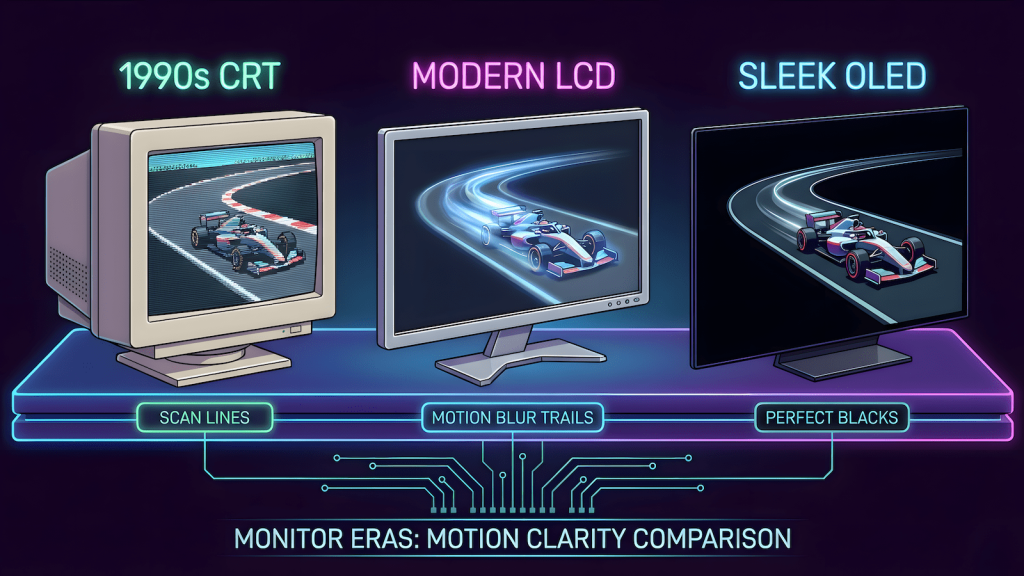
CRTs didn’t hold frames. They flashed them.
An electron beam would scan across phosphor-coated glass, draw the image, and the phosphor would decay almost instantly. The next frame arrived and the process repeated. This created what’s called impulse-based display: zero sample-and-hold blur, instant pixel response, clean motion at any refresh rate.
Even a cheap CGA CRT from the 80s had motion clarity that no modern LCD can match.
LCDs introduced a different model: sample-and-hold. The backlight stays on, pixels hold their state for the entire frame duration, and your eyes track across a static image that updates in discrete jumps. This creates motion blur as a byproduct of how the technology works.
Higher refresh rates reduce this blur by shortening how long each frame is held. But they don’t eliminate it.
High Hz is not a solution. It’s mitigation.
Why the Industry Sold Hz Instead of Solving Motion
When LCDs replaced CRTs, manufacturers lost the inherent motion clarity advantage. They couldn’t fix the physics of sample-and-hold displays without fundamentally changing the technology, so they did what any industry does when the real problem is too hard to explain:
They sold a number.
Hz became the metric because:
- It’s simple to market
- It’s easy to compare
- It sounds like progress
- People will pay for bigger numbers
Meanwhile, the actual problems (pixel response time, overdrive tuning, ghosting, inverse ghosting, frame pacing) got buried under spec sheets.
A well-tuned 60 Hz IPS panel can produce cleaner motion than a cheap 165 Hz TN display with aggressive overdrive. But “well-tuned overdrive curves” doesn’t fit on a box.
The Real-World Test: 165 Hz → 60 Hz
I used 165 Hz monitors for years. AOC 27G2SE panels, budget gaming displays, the kind Reddit swears you “can’t go back from.”
They died. I replaced them with a 2015 Dell U2713HM. A 60 Hz IPS panel. Workstation-grade, not gaming-focused.
My eyes adapted in minutes.
Not hours. Not days. Minutes.
Why? Because both are still LCD sample-and-hold displays. The motion blur model didn’t change; it just got slightly faster or slower. The Dell’s better panel quality, cleaner pixel response, and lack of aggressive overdrive artifacts made it feel smooth despite the lower refresh rate.
The 165 Hz AOCs needed high refresh rates to compensate for weaker panels. The Dell didn’t.
Good panels don’t need compensation.
Where CRTs Fit Into This
This is where it gets interesting.
I started on CRTs. Used them for decades. Switched to high-refresh LCDs years ago. Then dropped to 60 Hz LCD recently.
If Hz was the defining factor, that should have felt like a catastrophic downgrade.
It didn’t.
Because my brain already adapted to the real downgrade: CRT to LCD. That happened over a decade ago. The motion clarity I grew up with (instant pixel response, zero persistence, clean motion at any frame rate) was already gone.
165 Hz to 60 Hz is a small step within the same flawed technology. It’s more of the same blur, just slightly different timing.
The big lie is that going from 60 to 144 Hz brings you closer to CRT-level motion. It doesn’t. It just makes LCD blur slightly less bad.
Panel Quality Beats Refresh Rate
The Dell U2713HM proved something uncomfortable for the gaming monitor industry:
A high-quality 60 Hz panel built for color accuracy, response consistency, and clean overdrive can outperform cheap high-refresh panels in real-world use.
What the Dell does right:
- True IPS with stable color and viewing angles
- Consistent pixel response without overshoot
- Minimal processing artifacts
- High-quality scaler for clean frame delivery
- Uniformity and contrast stability
What budget 165 Hz gaming monitors do wrong:
- Cheap TN or IPS panels
- Aggressive overdrive to hit “1 ms” marketing claims
- Inverse ghosting and corona artifacts
- Poor low-FPS behavior
- Worse color depth, contrast, and uniformity
They need high Hz to feel acceptable. Quality panels don’t.
This is the sentence that breaks the myth:
High refresh rates often compensate for panel weaknesses. Good panels don’t need compensation.
The OLED Marketing Cycle Repeats
Now we’re seeing 240 Hz OLED monitors everywhere.
OLED fixes the real LCD problem: pixel response and motion persistence. Near-instant transitions, no ghosting, no overdrive bullshit. At 120 Hz, OLED already delivers motion clarity that approaches CRT levels.
So why push 240 Hz?
Because Hz is the only number marketing departments can still scream.
For esports grinding or frame-time obsession, 240 Hz OLED makes sense. For everyone else? 120 Hz OLED is already endgame. The extra Hz is diminishing returns on a problem that’s already solved.
But 240 Hz OLED monitors are overpriced, constantly out of stock, and suffering from early-adopter tax plus gaming tax.
Meanwhile, a 120 Hz OLED TV (LG C-series, Xiaomi, others) costs less, offers better HDR, and delivers the same motion clarity for non-competitive use.
And before you think “I’ll just add more monitors” as a productivity move, remember that multiple displays can become a productivity trap when visibility creates pressure instead of clarity.
Once pixel response and motion persistence are solved, refresh rate stops being the bottleneck.
When Hz Actually Matters
High refresh rates aren’t useless. But they’re niche.
They matter when:
- You’re in competitive shooters where frame timing affects aim
- You’re pushing consistent >144 FPS and can actually use the headroom
- You’re tracking fast motion and need tighter input latency
- You’ve trained your reflexes to that cadence
For story-driven games, third-person titles, anything that isn’t twitch-based competitive play? The difference between 60 Hz and 165 Hz is marginal at best.
Stable 60 > unstable 144. Stable 144 > unstable 240.
Frame pacing and consistency beat peak Hz every time.
What Your Eyes Actually Adapt To
People claim “once you see 144 Hz you can never go back to 60.”
That’s conditioning, not biology.
If you stare at 144 Hz for months, then force yourself back to 60 Hz, you’ll notice the difference. Your brain got used to faster updates.
But if your baseline is 60 Hz? Your visual system normalizes. Consistency matters more than peak spec.
I lived at 165 Hz for years. Dropped to 60 Hz. My eyes didn’t rebel because:
- The motion type didn’t change (still LCD sample-and-hold)
- The frame pacing was clean (stable GPU output, no stutter)
- My gameplay didn’t rely on the edge cases where Hz matters (not competitive, not twitch shooters)
You can’t miss what you didn’t hardwire into your perceptual baseline.
The Hardware Spec Trap
This same pattern plays out across PC hardware.
People build systems chasing numbers instead of use cases:
- 240 Hz monitors for games that run at 75 FPS
- RGB lighting that adds zero performance
- Ultra settings that double GPU load for textures you’ll never notice
- Flagship CPUs paired with midrange GPUs (or vice versa)
Just like treating furniture as decor instead of mission-critical gear, buying monitors based on spec sheets instead of actual workload creates setups that look impressive but underperform in real use.
A balanced i7-8700 + GTX 1660 system from 2017 still runs Division 2, AC Valhalla, Witcher 3 smoothly at 1080p High in 2026. No ray tracing, no DLSS, no problem.
A Ryzen 5 5600H + RTX 3050 Ti laptop is slightly stronger overall, has DLSS for newer titles, but isn’t a night-and-day difference for story-driven gameplay.
Both are smooth enough. Neither needs an upgrade unless the library demands it.
The real rule: match your hardware to your actual workload, not the hype cycle.
Why This Matters Beyond Monitors
Chasing specs isn’t just wasted money. It’s wasted mental load.
Every hardware cycle, every benchmark comparison, every “am I falling behind” question: it’s all energy spent solving problems you don’t have.
A system that just works means:
- Fewer distractions
- Less noise and heat
- Less guilt over not upgrading
- More time actually using the thing
High refresh rate obsession is a symptom of a larger problem: letting marketing define your needs instead of your actual experience.
The Takeaway
CRTs had perfect motion. LCDs never did. High refresh LCDs soften the pain but they don’t fix the physics.
Good panel behavior beats spec numbers. A well-engineered 60 Hz display can outperform cheap high-Hz panels in real-world use.
Hz matters in narrow edge cases. For everyone else, it’s a comfort metric sold as a necessity.
Stop chasing Hz numbers. Focus on panel quality, frame pacing, and what your brain can actually process.
Your eyes already took the real downgrade when CRTs died. Everything since has been mitigation, not progress.
Build for your use case, not for someone else’s benchmarks. Your system will last years longer than the hype machine says it should.
Written from experience: decades on CRTs, years on high-refresh LCDs, now using a 60 Hz IPS panel that feels better than the “gaming monitors” it replaced. The spec sheet lied. The display didn’t.