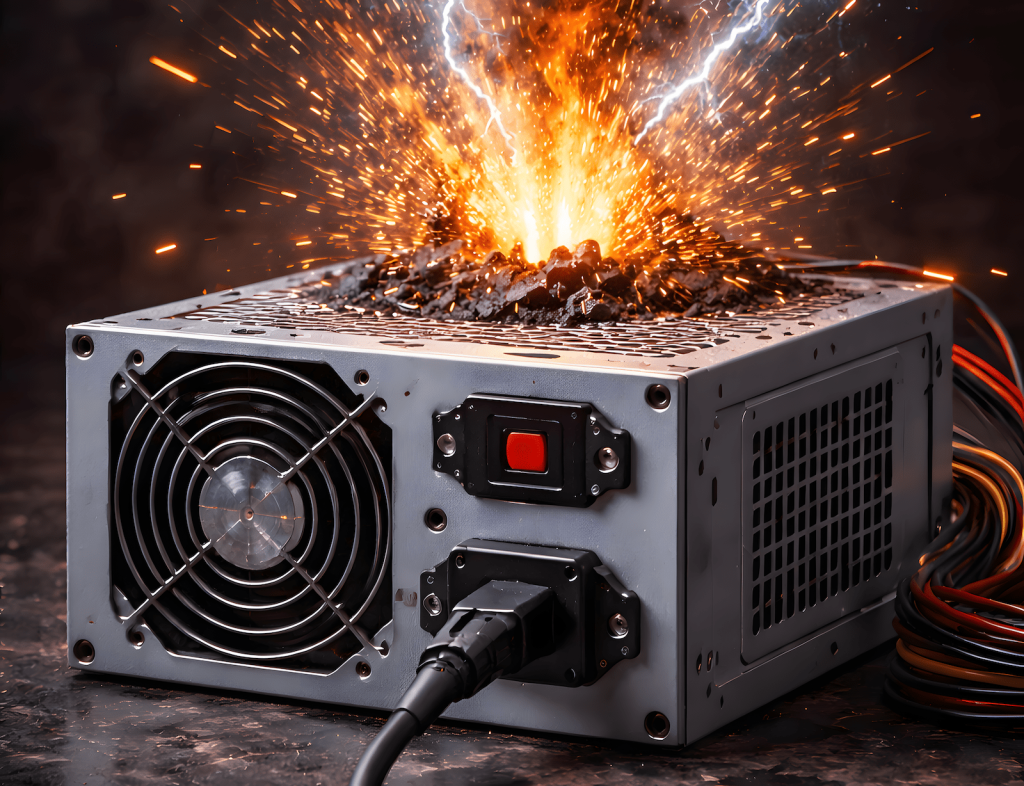
Every generation brings the same panic.
Stock fans are “trash.” Stock coolers are “not enough.” You need more fans. Bigger fans. Faster fans. An AIO. A custom loop. Something, anything, to fix the heat.
Most of the time, that advice is solving the wrong problem.
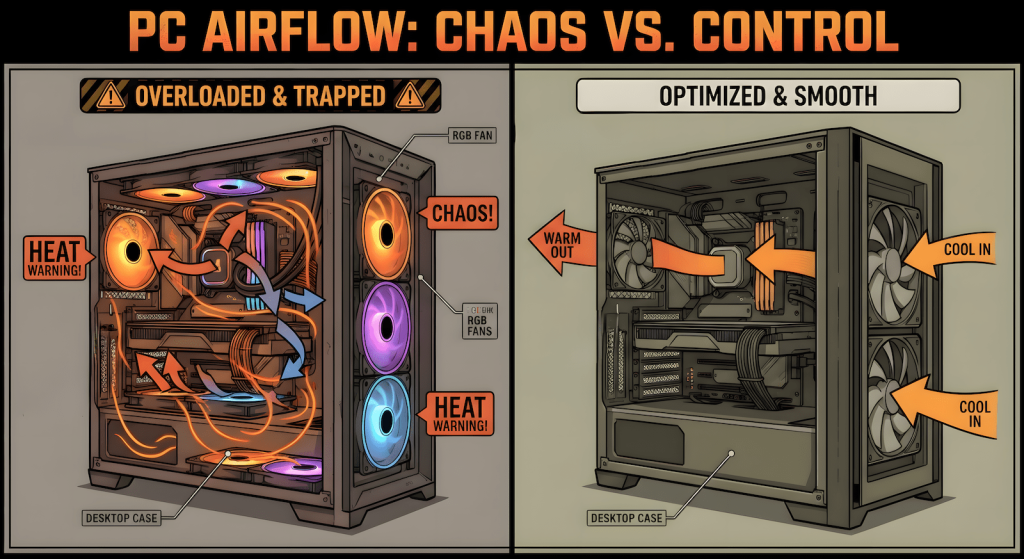
The issue isn’t the fans. It’s airflow, or the lack of it.
Why I don’t panic about cooling
I didn’t start with gaming rigs or enthusiast hardware. I started with a 286, then a 486, then early Pentium systems.
Back then, cooling wasn’t a talking point. Systems ran warm, loud, and continuously. You didn’t tweak parts to squeeze performance. You learned how they worked so you wouldn’t break them.
Later on, most of the machines I used weren’t “gaming PCs” at all. They were business systems. Dell, HP, office-grade machines expected to run multiple applications all day without intervention.
They weren’t optimized for looks. They were optimized to stay on and stay alive.
That baseline matters, because it shapes how I look at modern cooling advice.
What stock fans and stock coolers are actually designed for
Stock cooling isn’t designed for overclocking, silence chasing, aesthetic builds, or benchmark screenshots.
It is designed for stock power targets, sustained operation, worst-case ambient temperatures, zero user tuning, and long uptime.
If stock cooling were genuinely “bad,” offices and workstations would be failing constantly. They aren’t.
Stock cooling is boring by design, and boring is usually what you want.
Where the fan panic comes from
Most “you need better fans” advice comes from one of three places.
Stacked upgrades. New CPU, new GPU, aggressive boost behavior, then heat shows up and the cooler gets blamed.
Bad cases. Solid front panels, blocked intakes, decorative vents. Airflow was never given a chance.
Noise obsession. Quiet doesn’t mean cool. Quiet often just means heat is being trapped longer. The silence-chasing starts because YouTube reviews and marketing have convinced people that PC noise is unacceptable, so they prioritize low RPMs over actual thermal performance.
Fans become the scapegoat because they’re the easiest thing to swap.
The benchmark problem
Electronics generate heat. The more power you push, the more heat you get. That’s not a flaw, that’s physics.
Cooler systems do run better. But the real question isn’t “what’s the best cooling,” it’s “what cooling do I actually need for what I do?”
Most cooling advice comes from YouTube channels like Linus Tech Tips, Gamers Nexus, JayzTwoCents. Their job is to test limits, break systems, and set benchmarks. They have lab budgets, multiple high-end rigs, and content goals that require pushing hardware until it fails or throttles.
That work is valuable. It sets reference points. It shows what’s possible. But it’s not daily-life context.
When someone watches a stress test where a CPU hits 95°C under sustained all-core load, they panic. Then they buy cooling meant for workloads they’ll never actually run.
A graphic artist and a video editor might both need “powerful systems,” but their thermal loads are different. Their workflows are different. The tools they use most are different. Even if two people run the same software, the way they use it won’t be identical.
Cooling advice that works for someone rendering 4K timelines for eight hours straight doesn’t automatically apply to someone who games for two hours after work.
The mismatch happens when people solve for benchmark scenarios instead of their actual use case.
Fans matter less than how air moves
This is the part nobody wants to hear.
One good airflow path beats six expensive fans fighting each other.
What actually matters: clear front intake, unobstructed airflow path, sensible exhaust, fans working with each other, not against each other.
You don’t fix airflow by adding more fans. You fix airflow by letting air move predictably.
A basic stock cooler in a well-ventilated case will outperform a premium cooler trapped in bad airflow every time.
Cooling is a system, not a shopping list.
The reality of hot environments
I live in the Philippines. Ambient temperatures can sit around 34°C.
When I game, the room heats up. That’s not a cooling failure, that’s physics.
The solution isn’t exotic hardware. It’s airflow through the room, cycling hot air out, not pretending heat disappears inside a sealed box.
My PC sits near a window. I use an electric fan to move air. Heat leaves the room, and the stock fans do their job.
Cooling doesn’t stop at the case.
Why big coolers and AIOs don’t fix bad airflow
I’ve used large air coolers and AIOs.
They’re quieter. They look better. They lower peak temperatures.
What they don’t do: fix bad airflow, change how the PC feels at stock settings, justify their cost if the system wasn’t thermally constrained to begin with.
If your system needs an AIO just to operate comfortably at stock clocks, something else is wrong.
Cooling upgrades shouldn’t be emergency measures.
What “enough cooling” actually looks like
For normal use, work, gaming, long uptime, enough cooling looks like stable temperatures within spec, no thermal throttling, smooth performance, zero attention required.
I don’t care about peak benchmark numbers. I care if it’s smooth and stable.
If the system disappears into the background, cooling succeeded.
The takeaway
Most people don’t need better fans.
They need better airflow, realistic expectations, fewer stacked mistakes.
Stock fans and stock coolers aren’t trash. They’re honest.
When cooling becomes the main event, you’re usually compensating for bad decisions elsewhere.
Fix the airflow first. Then decide if you actually need anything more.

Started with 286 and 486 systems where cooling was about keeping machines alive, not making them quiet or pretty. Ran stock-cooled business and home PCs for years, often left on for long stretches, in tropical heat without tuning or fan obsession.
Runs HobbyEngineered, where hardware is judged by airflow, stability, and real-world uptime not RGB counts, benchmark charts, or influencer advice.
Also writes about QA systems at QA Journey and cuts through AI hype at Engineered AI.
Same engineer mindset, different tools.