Before battlemats, resin terrain, and 3D printers, tabletop RPG environments had a simpler requirement: they needed to exist at all.
Imagination carries a lot of weight at the table, but it works better when there’s something physical anchoring it. A wall. A building. A sense of distance. A place where “over there” actually means something.
You don’t solve that by buying terrain. You solve it by building.
Environment First, Rules Second
The goal isn’t a perfect game board. It’s a physical environment. Something you can look at, point to, move around, and imagine happening inside.
Think of these as display pieces. Still life scenes inspired by house magazines, arts and crafts books, scale models. The fact that they support tabletop play is a feature, not the primary objective.
That’s an important distinction.
Modern tabletop terrain is often disposable. Build for one encounter, tear down, replace. What you should be building are persistent locations. Houses, yards, towers, bunkers. Things that exist beyond a single session.
Campaign locations, not battle maps.
The Material System (No Shopping Required)
The system is simple because it has to be.
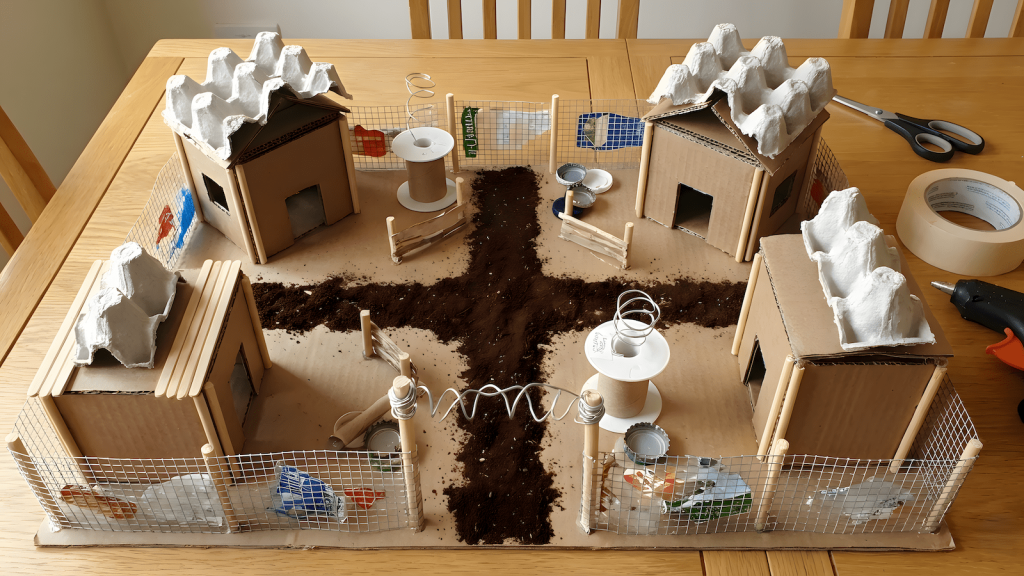
Cardboard boxes for walls. Corrugated cardboard, ripped open, for roofing texture. Barbecue sticks for posts, beams, and structure. Old candy boxes for window panes. Mesh screens for terraces and fencing. Random wires and discarded electronics for industrial details.
Nothing exotic. Nothing specialized. If it requires a trip to the store, it probably doesn’t belong.
The only things worth buying are tools that unlock reuse. A knife, glue, a bit of paint. Everything else comes from what’s already lying around.
That’s not a limitation. That’s the point.
Once the solution becomes “buy foamboard,” the problem stops being engineering and starts being consumption. At that point, you’re not building. You’re shopping.
Let Scale Emerge From Available Objects
Don’t pick a scale. Let the available objects pick it for you.
Matchbox cars, toy soldiers, plastic trees. Those are your references. If a car fits the driveway, the house works. If soldiers don’t look ridiculous next to a wall, the proportions are close enough.
That constraint keeps everything small, grounded, and consistent. It also forces real spatial thinking. Door height, roof angles, yard size. You can’t fake it because the objects will expose you immediately.
That’s tabletop logic.
When you work this way, the builds start telling their own stories. A bunker doesn’t need a rulebook to justify why it’s there. It exists. It has a door, windows at specific heights, a roofline that suggests age or purpose. The environment comes first. The narrative grows out of it.
That’s backwards from how most people approach worldbuilding now, but it works.
Mistakes Are the Process
Nothing works cleanly the first time.
Walls lean. Roofs collapse. Paint looks wrong. Scale drifts. Some builds get scrapped entirely.
That’s not failure. That’s feedback.
Modern advice like “5 mistakes beginners should avoid” misses the point completely. You’re a beginner. Mistakes aren’t optional. They’re the job description.
If you’re not making mistakes, you’re not building. You’re following instructions.
The skill isn’t cutting cardboard. It’s learning how to translate an image in your head into something physical, seeing where reality pushes back, and adjusting on the next build.
That’s the same skill a good tabletop GM uses. Run a scene, watch what breaks, adapt.
Every failed roof teaches you something about structure. Every wall that doesn’t hold teaches you about material properties. Every paint job that looks like garbage teaches you about color theory and contrast. The mistakes aren’t obstacles. They’re the curriculum.
Build the Space, Let the Game Follow
Here’s where this approach gets interesting.
You’re not building terrain for D&D encounters or Warhammer skirmishes. You’re building dioramas that function as game boards, but the game is yours.
Why lock yourself into one RPG system when you can build a campaign that exists because the environment exists? The locations come first. The rules, the story, the mechanics, those grow out of what’s already there.
A town isn’t a town because the rulebook says it’s a town. It’s a town because you built the buildings, the streets, the places where things happen. At that point, running a campaign becomes less about following a module and more about exploring a place that already has physical presence.
Start with what you have. Let the constraints define the solution. Don’t shop your way out of the problem.
Build the space. Let the game follow.
Why the References Matter Now
Today, the references are wider. The Witcher’s Kaer Morhen. Division’s SHD safehouses and control points. Fallout’s vaults, Diamond City, New Vegas. RDR2’s Valentine and Strawberry. Environmental storytelling is everywhere.
But the core problem hasn’t changed. How do you turn an imagined space into something coherent at the table?
Buying more stuff doesn’t answer that. Thinking does.
The tools are better now. The references are better. The materials haven’t changed. Cardboard is still cardboard. But the approach is the same.
Start with what’s around you. Accept constraints as fixed. Solve the problem anyway.
The System in Practice
Here’s what this looks like when you actually do it.
You find a cardboard box. You decide it’s a house. You cut windows where they make sense structurally. You use barbecue sticks to frame a door. You rip corrugated cardboard for the roof because the texture reads as shingles at small scale.
You don’t measure. You eyeball. You adjust. You see what works.
The house gets a yard. Mesh screen becomes a fence. Candy box plastic becomes a window. Wire becomes a clothesline or a power line or whatever the scene needs.
Nothing matches. Nothing is clean. But it reads as a location.
That’s the goal.
You’re not producing perfect terrain. You’re developing a system that works under constraint. Start with what you have. Build the simplest version. Learn from what fails. Improve the next one.
No templates. No specs. No shopping lists.
That’s HobbyEngineered. Start with what’s around you. Accept constraints as fixed. Solve the problem anyway.

Treats hobbies the same way he treats systems. Process matters more than outcomes. Builds under constraint, learns by breaking things, and distrusts any hobby that starts with a shopping list. Prefers tools and materials that push back and force decisions instead of offering shortcuts.
Runs HobbyEngineered, a place for hobbies that reward patience, feedback, and repeatable effort. If convenience is the selling point, it probably does not belong here.